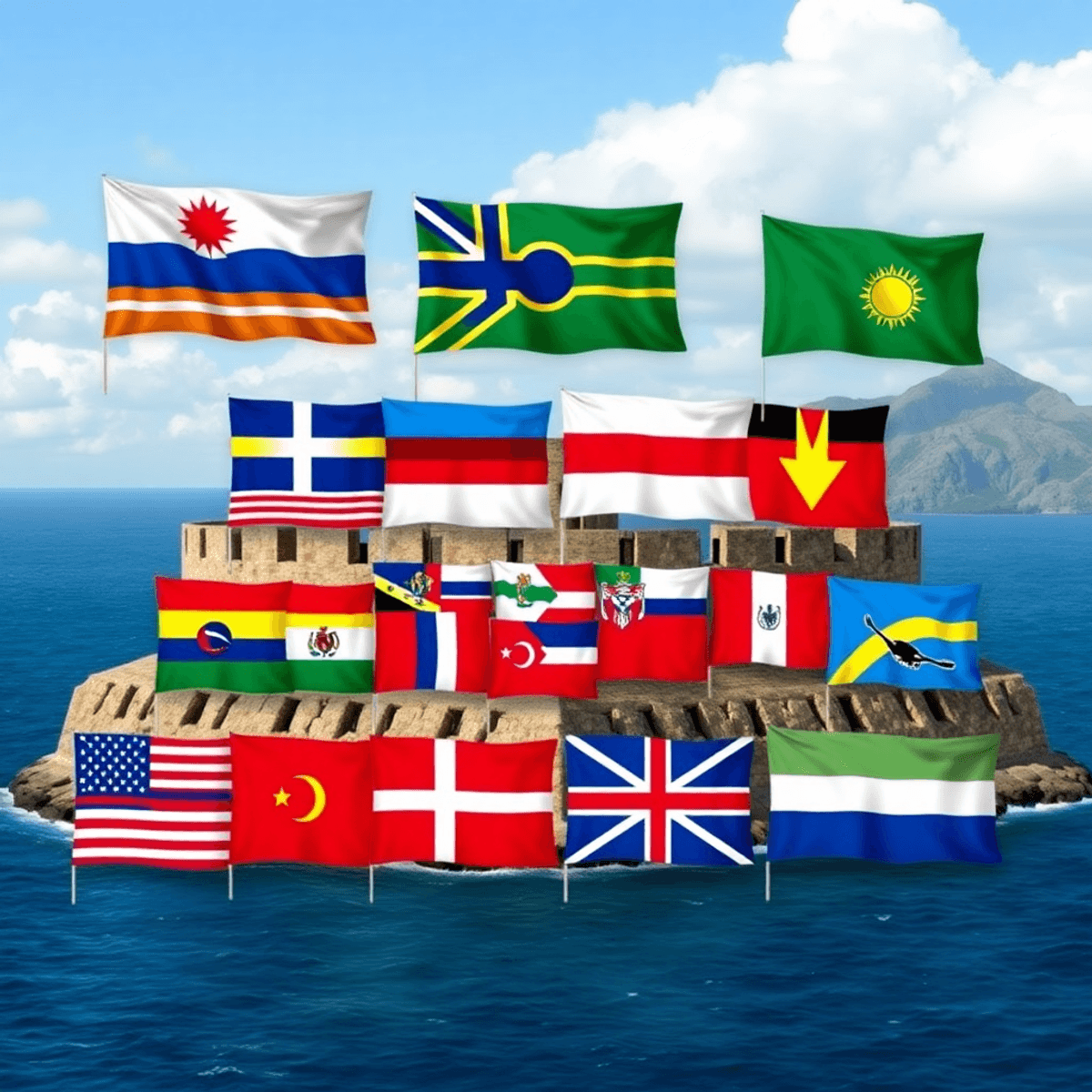
Imagine a remote sea fort off the British coast, where a small group of people proudly raise their unique flag, declaring independence from all recognized nations. This scene is not limited to just one place; it is happening worldwide, from Australian backyards to online spaces, as self-proclaimed micronations create their own flags to symbolize their desire for self-governance.
Micronations are entities that declare themselves independent but do not have international recognition. These self-declared nations use flags as a way to express their identity and communicate their aspirations. Each flag is carefully designed, incorporating colors, symbols, and patterns that hold significance for the founders.
The world of micronation flags offers valuable insights into human desires for freedom and acknowledgment. Some designs advocate for environmental causes, while others challenge government policies or celebrate indigenous heritage. These flags act as visual declarations of independence in various locations, including abandoned places and virtual realms.
In this article, we will explore the most intriguing flags of self-declared micronations. We will analyze their:
- Design elements and symbolism
- Cultural significance
- Political motivations
- Historical context
- Claims to sovereignty
By examining these unique banners, we can gain a better understanding of how micronations redefine traditional notions of nationhood and convey their distinct visions of freedom in an interconnected world. Additionally, we will draw parallels with the mythical flags representing lost civilizations and ancient legends such as Atlantis and Hyperborea. Moreover, we will discuss the flags of fictional nations, which embody creativity and imagined identities.
Understanding Micronations and Their Distinction from Microstates
There is an important difference between microstates and micronations in the international community. Microstates like Vatican City, Monaco, and San Marino have legitimate sovereignty with full diplomatic recognition, while micronations operate as self-declared entities without legal acknowledgment.
The Criteria for State Sovereignty
According to international law, state sovereignty requires certain conditions to be met:
- Permanent population
- Defined territory
- Functioning government
- Capacity to enter relations with other states
Micronations do not fulfill these established requirements, which puts them outside the framework of recognized nation-states. The 1969 Vienna Convention on the Law of Treaties supports these principles by defining sovereign states as entities capable of making international agreements.
The Rise of Micronations
The modern movement of micronations started gaining popularity in the late 20th century. It was driven by individuals and groups who were looking for different ways to govern themselves. Some notable examples from this time include the Republic of Rose Island (1968) and the Principality of Sealand (1967), which were early attempts at creating independent territories.
Why Do People Create Micronations?
There are various reasons why people decide to establish micronations:
- Political Protest: Some individuals use micronations as a means to challenge existing government policies.
- Artistic Expression: Others create conceptual spaces and identities through artistic endeavors.
- Theoretical Experiments: Certain individuals test alternative governance models as part of theoretical experiments.
- Personal Entertainment: Building fictional realms serves as a form of personal entertainment for some.
- Social Activism: Advocating for specific causes or rights is another motivation behind founding micronations.
Despite lacking international recognition, these self-declared countries often set up complex structures resembling those of actual states. They create constitutions, currencies, and diplomatic protocols in an effort to establish their legitimacy.
The Role of Flags in Micronation Identity and Sovereignty Claims
Flags are the main visual representatives of micronations, turning the abstract idea of sovereignty into concrete symbols that embody these self-proclaimed states. Every design element in a micronation flag has a specific meaning, from the choice of colors to the shapes and symbols used. To fully grasp the significance behind these flags, it can be helpful to [understand their colors, shapes, and symbols](https://lostflags.com/how-to-read-a-flag-colors-shapes-and-hidden-meanings), uncovering rich cultural and historical narratives.
Communication Power of Flags
These flags serve as effective means of communication, conveying particular messages to both its members and outside observers:
- Internal Unity: Flags foster a sense of belonging among micronation members, strengthening community identity.
- External Recognition: Design elements often mimic established sovereign states to project legitimacy.
- Historical Connection: Symbols frequently reference local heritage or founding principles.
- Political Statement: Visual protests against existing governments or social systems.
Common Symbolic Themes in Micronation Flags
The motivations behind micronation flags are diverse, as reflected in their symbolic themes:
- 🗽 Libertarian Values: Stars, broken chains, or eagles representing freedom.
- 🌿 Environmental Causes: Green fields, trees, or wildlife depicting ecological focus.
- ⚔️ Cultural Heritage: Traditional patterns, ancestral symbols, or historical references.
- ✊ Political Protest: Modified versions of existing national flags or satirical elements.
Understanding Flag Design Complexity
The complexity of flag designs varies greatly. Some micronations opt for simple yet powerful statements while others create intricate compositions influenced by heraldry. While certain micronations embrace conventional flag features like stripes and crosses, there are those who invent entirely new symbolic languages through their choices in vexillology. For example, exploring [the evolution of flag design](https://lostflags.com/the-evolution-of-flag-design-a-vexillologists-guide-to-lost-banners) can offer valuable insights into the symbolism and history behind these distinctive banners.
Diplomatic Significance of Micronation Flags
During inter-micronational gatherings, where multiple micronations come together, their flags assume an additional role as diplomatic instruments. In this context, these symbols become markers of shared identity and mutual acknowledgment among similar entities.
Notable Micronation Flags Around the World
The Principality of Sealand stands as one of history’s most intriguing examples of self-declared sovereignty, with its distinctive flag reflecting both maritime heritage and bold independence claims.
1. Principality of Sealand (United Kingdom)
Located on HM Fort Roughs, a World War II sea fort in the North Sea, Sealand’s origin traces back to 1967 when Roy Bates established his sovereign principality on this abandoned military platform. The fort’s location, situated 7 nautical miles off the coast of Suffolk, England, positioned it in what Bates claimed to be international waters.

The Elements of the Sealand Flag
The Sealand flag features:
- Red and black diagonal design – Split diagonally from the top hoist to the bottom fly
- White triangle – Located in the upper fly section
- Bold colors symbolism:
- Red represents strength and determination
- Black symbolizes the fort’s military history
- White signifies purity of purpose
Inspiration Behind the Flag Design
The flag’s design draws inspiration from naval signal flags, reflecting Sealand’s maritime location and heritage. Its stark geometric patterns ensure visibility at sea – a crucial consideration for a nation claiming sovereignty over maritime territory.
Key Events Involving Sealand’s Flag
Sealand’s flag gained international attention during several notable incidents:
- 1968 – First raised during warning shots fired at British Navy vessels
- 1978 – Defended during the “Sealand Rebellion”
- 1987 – Extended territorial waters claim under the flag
Significance of Flag Display Protocols
The principality maintains strict protocols regarding flag display, emphasizing its role in legitimizing Sealand’s sovereignty claims. Despite lacking international recognition, Sealand’s flag continues flying over the North Sea, marking one of the world’s most resilient micronations. These flag display protocols are crucial as they underline the principality’s commitment to its self-proclaimed sovereignty.
Core Values Represented by Sealand’s Flag
The flag represents Sealand’s core values:
- Independence from established nations
- Maritime sovereignty
- Historical military connection
- Determination to maintain autonomy
Grand Duchy of Flandrensis (Antarctica claim)
The Grand Duchy of Flandrensis is a one-of-a-kind micronation that claims territory in Antarctica. It was created mainly as a way to protest against environmental issues. The flag of Flandrensis represents this mission with its intentional symbolism – a bold design featuring five diagonal stripes in white and green.
Symbolism behind the flag
- The white stripes represent the Antarctic ice sheets, highlighting the micronation’s connection to the polar region.
- Green stripes symbolize environmental protection and sustainability, core values that drive Flandrensis’s mission to raise awareness about climate change and polar ice melt.
- A distinctive yellow pentagon sits at the flag’s center, containing a black compass rose. This emblem signifies both navigation and direction, pointing to Antarctica’s geographical position while representing the micronation’s guided purpose in environmental advocacy.
The flag’s design reflects Flandrensis’s dual identity as both a symbolic Antarctic territory and an environmental movement. Through their flag, they communicate their commitment to protecting polar regions and raising global awareness about climate change impacts on Antarctica’s fragile ecosystem.

Empire of Atlantium (Australia)
The Empire of Atlantium’s flag stands as a bold statement against traditional national borders. Created in 1981 by George Francis Cruickshank, this Australian-based micronation uses its distinctive flag to promote global governance and free movement of people.

The flag features three horizontal stripes in orange, white, and green. A striking navy blue triangle extends from the hoist, containing a golden southern cross constellation. The orange represents enlightenment and progress, while green symbolizes the earth’s natural environment. The white center stripe signifies peace and unity among all peoples.
The southern cross constellation pays homage to Atlantium’s Australian location, but recontextualizes this symbol to represent universal human rights rather than national identity. The flag’s design deliberately avoids traditional nationalist imagery, instead incorporating elements that emphasize:
- Global citizenship
- Cultural inclusivity
- Freedom of movement
- Universal human rights
- Secular humanist values
Based in Sydney, Atlantium’s flag flies over its 200-square-meter territorial claim at Aurora, New South Wales, where it serves as a visual manifesto for the micronation’s progressive ideals.
Murrawarri Republic (Indigenous Australian claim)
The Murrawarri Republic is a strong example of Indigenous Australian sovereignty claims. It was declared in 2013 and includes ancestral lands in New South Wales and Queensland. The Republic’s flag has a special meaning and represents their culture through its carefully chosen design elements.
Flag Design
The flag features three horizontal stripes – black, yellow, and red – colors traditionally associated with Aboriginal Australian identity. A central white circle contains the Murrawarri totem, the Cod fish, representing the spiritual connection to water and sustenance. The surrounding pattern of dots draws from traditional Aboriginal art techniques, symbolizing the continuous flow of life and connection to country.

Symbolism
Each element of the Murrawarri flag serves as a visual declaration of Indigenous rights and self-determination. The black stripe represents the people, yellow symbolizes the sun that gives life, red signifies the sacred earth. This thoughtful incorporation of cultural symbols transforms their flag into a powerful statement of Indigenous heritage and political autonomy.
The Murrawarri Republic’s flag design demonstrates how micronations can use traditional symbolism to assert legitimate historical claims to sovereignty, distinguishing it from purely conceptual or protest-based micronational movements.
Elgaland-Vargaland (Conceptual borders)
The Kingdom of Elgaland-Vargaland presents a unique artistic interpretation of nationhood through its distinctive flag design. Created by artists Carl Michael von Hausswolff and Leif Elggren in 1992, this micronation claims sovereignty over all border territories between nations and mental spaces.
Their flag features a stark black and white design split diagonally, representing the liminal spaces between physical and conceptual realms. The deliberate simplicity of the two-tone pattern symbolizes the binary nature of borders – the separation between here and there, known and unknown.

The flag’s artistic minimalism reflects the micronation’s philosophical foundation:
- Black represents the void and unexplored territories
- White symbolizes the potential for new definitions of space
- The diagonal division suggests movement between realms
The flag flies at various art installations and performances worldwide, marking Elgaland-Vargaland’s presence in galleries, museums, and border crossings. This artistic approach to sovereignty challenges traditional concepts of nationhood by claiming ownership over intangible spaces that exist between recognized territories.
Common Elements in Micronation Flags: A Symbolic Analysis
Micronation flags share distinctive design patterns that reflect their founders’ aspirations, cultural heritage, and political ideologies. These visual elements create a rich symbolic language unique to each micronation while following certain recurring themes.
Color Symbolism:
- Green – Environmental protection, sustainability, natural resources
- Red – Revolution, resistance, sovereignty
- Blue – Maritime claims, freedom, independence
- Gold/Yellow – Prosperity, wealth, dignity
- Black – Opposition to existing power structures
Common Emblems and Their Meanings:
- Stars – Unity, independence, cosmic connections
- Rising Sun – New beginnings, hope
- Animals – Local wildlife, strength (lions), wisdom (owls)
- Plants – Indigenous flora, growth, renewal
- Geometric Shapes – Mathematical precision, order
Heraldic Elements:
- Invented Coats of Arms – Historical legitimacy
- Traditional Symbols – Cultural heritage
- Abstract Designs – Modern interpretations
- Cross Patterns – Religious or cultural significance
- Shields – Protection, defense of sovereignty
Many micronations incorporate multiple layers of meaning into their flag designs. The Grand Duchy of Flandrensis combines environmental green with Antarctic imagery, while the Empire of Atlantium uses abstract geometric patterns to represent global unity. These symbolic choices help establish distinct identities and communicate complex political messages through visual means.
The artistic expression in micronation flags ranges from sophisticated heraldry to minimalist modern designs, each carefully crafted to represent the unique vision of their creators and communities.
The Evolution of Micronationalism in the Digital Age and Its Impact on Flag Usage
The internet age has changed how micronations establish and express their sovereignty. Digital platforms create boundless opportunities for virtual nations to flourish without physical territories, leading to innovative approaches in flag design and usage.
Flags in the Online World
Virtual micronations now display their flags across:
- Social media profiles
- Discord servers
- Dedicated websites
These digital emblems serve as powerful identity markers in online spaces, fostering community engagement and legitimacy within specialized forums and social networks.
Creative Flag Design
The accessibility of design software has sparked creative experimentation in flag creation. Digital micronations often incorporate:
- Pixel art elements reflecting internet culture
- QR codes linking to official websites
- Dynamic elements that change based on user interaction
- Animated versions for social media
Platforms for Digital Micronations
Popular platforms for digital micronations include:
- Discord communities with flag-based role assignments
- Reddit forums dedicated to micronational diplomacy
- Virtual worlds hosting micronational embassies
- Social media accounts using flags as profile badges
Blockchain and Flags
The rise of blockchain technology has introduced new dimensions to digital sovereignty claims. Some micronations now mint their flags as NFTs or incorporate cryptocurrency symbols into their designs, reflecting their embrace of digital-native governance structures.
These virtual communities demonstrate how traditional concepts of flags and sovereignty adapt to technological change. Their flags exist primarily as digital assets, yet carry significant meaning for community members who rally under these symbols in online spaces.
Diplomatic Interactions Among Micronations: The Role of Flags in These Exchanges
Micronations engage in diplomatic ceremonies and summits where their flags take center stage as powerful symbols of sovereignty. These gatherings, such as the PoliNation conference in London and the Intermicronational Summit in Atlanta, create spaces where self-declared nations display their banners side by side – a practice that mirrors traditional international diplomacy.
The Grand Duchy of Westarctica hosts annual diplomatic receptions where visiting micronational leaders present their credentials under their respective flags. These ceremonies, while lacking international legal standing, demonstrate the deep significance of flag protocols in micronational diplomacy.
Flags in Official Documentation
Micronations incorporate their flags into official documentation to reinforce their claims of legitimacy:
- Citizenship Documents: The Republic of Molossia prints passports featuring their national flag
- Treaties: The Principality of Hutt River (now dissolved) signed agreements with other micronations under their respective flags
- Diplomatic Credentials: The Empire of Austenasia issues ambassador appointments bearing their flag seal
Flags at MicroCon Gatherings
The MicroCon gatherings represent pinnacle events in micronational diplomacy. At these conferences, flags serve as visual anchors for:
- Identity representation during formal presentations
- Ceremonial exchanges between leaders
- Photo opportunities documenting inter-micronational relations
- Display in conference halls alongside other micronational symbols
These diplomatic exchanges, centered around flag displays and protocols, create a parallel diplomatic universe where micronations acknowledge each other’s claims to sovereignty through mutual recognition of their national symbols.
Case Study: The Dissolution of the Principality of Hutt River – What Happened to Its Flag?
The Principality of Hutt River was Australia’s longest-running micronation, existing from 1970 to 2020. Its founder, Leonard Casley, declared independence after a disagreement with the Western Australian government over wheat production quotas. He took on the title “Prince Leonard I” and created a sovereign entity on his 75-square-kilometer wheat farm.
The Design and Significance of the Hutt River Flag
The Hutt River flag represented the agricultural heritage of the area through its unique design:
- A white background symbolizing purity and peace
- A blue cross representing the region’s Christian values
- Five green squares depicting the territory’s fertile farmland
- A red crown signifying the principality’s monarchical system
For five decades, this flag proudly flew over the self-proclaimed principality, appearing on passports, coins, and stamps. The micronation attracted tourists and media attention, with visitors buying souvenirs featuring the iconic flag design.
The Impact of COVID-19 and the Dissolution of Hutt River
The COVID-19 pandemic delivered a devastating blow to Hutt River’s operations in 2020. With increasing tax debt and declining tourism revenue, the ruling family officially dissolved the principality. The flag, once a symbol of resistance against government authority, now exists as a historical artifact in private collections and museums.
Preserving Hutt River’s Cultural Legacy
The dissolution sparked interest in preserving Hutt River’s cultural legacy. Former citizens and collectors protect remaining flags as tangible reminders of this audacious experiment in self-declared sovereignty. These preserved flags serve as educational tools, illustrating how micronations use visual symbols to assert independence claims and create distinct identities.
Broader Implications: What Micronation Flags Tell Us About Nationhood and Identity Today
The flags of micronations serve as powerful mirrors reflecting deeper human aspirations beyond traditional state structures. These symbolic designs challenge established definitions of nationhood by demonstrating how communities can forge identities independent of legal recognition.
A Fascinating Paradox
The proliferation of micronation flags reveals a fascinating paradox: while these entities reject conventional state authority, they often adopt traditional symbols of sovereignty. This pattern suggests an innate human need to belong to distinct cultural groups, even when operating outside recognized political frameworks.
Key Insights from Micronation Flag Designs
Consider these key insights from micronation flag designs:
- Identity Expression: The creative freedom in micronation flags allows communities to represent their values without conforming to established vexillological rules
- Cultural Resistance: Many designs incorporate elements that deliberately contrast with their host nations’ symbols, asserting unique cultural narratives
- Digital Age Adaptation: Modern micronations embrace innovative flag designs that reflect virtual communities and borderless identities
Evolving Symbols of Sovereignty
The phenomenon of micronation flags highlights how symbols of sovereignty continue to evolve in our interconnected world. These flags demonstrate that national identity exists on a spectrum rather than within rigid state boundaries. Their designs push us to reconsider traditional notions of legitimacy and belonging in an era where digital communities can rival physical ones in terms of cultural impact.
Crafting Visual Representations of Collective Identity
The persistence of flag creation among self-declared nations underscores humanity’s enduring desire to craft visual representations of collective identity, regardless of international recognition or territorial claims.
Conclusion
Micronation flags reveal deep truths about human desires for recognition, belonging, and self-determination. These carefully designed symbols—whether flying over a sea fort, an Antarctic claim, or a digital realm—represent more than mere artistic expression. They embody the enduring human drive to create meaningful communities outside traditional state structures.
The various micronation flags we’ve looked at show how visual symbolism can convey complex political beliefs, cultural heritage, and social protests. Each flag tells a unique story of alternative nation-building, from Sealand’s maritime-inspired design to Flandrensis’s environmental message.
These flags remind us that sovereignty and nationhood go beyond internationally recognized borders. They challenge us to think about how communities shape their identities and assert their presence in an increasingly connected world. The persistence of micronations and their symbols suggests that the human need for collective identity and self-governance remains strong, even as traditional ideas of statehood change.
Studying micronation flags gives us valuable insights into grassroots movements, artistic expression, and political activism. These symbols continue to inspire new ways of organizing communities and resisting oppression, showing that flags and sovereignty are still important tools for groups seeking recognition and legitimacy today.