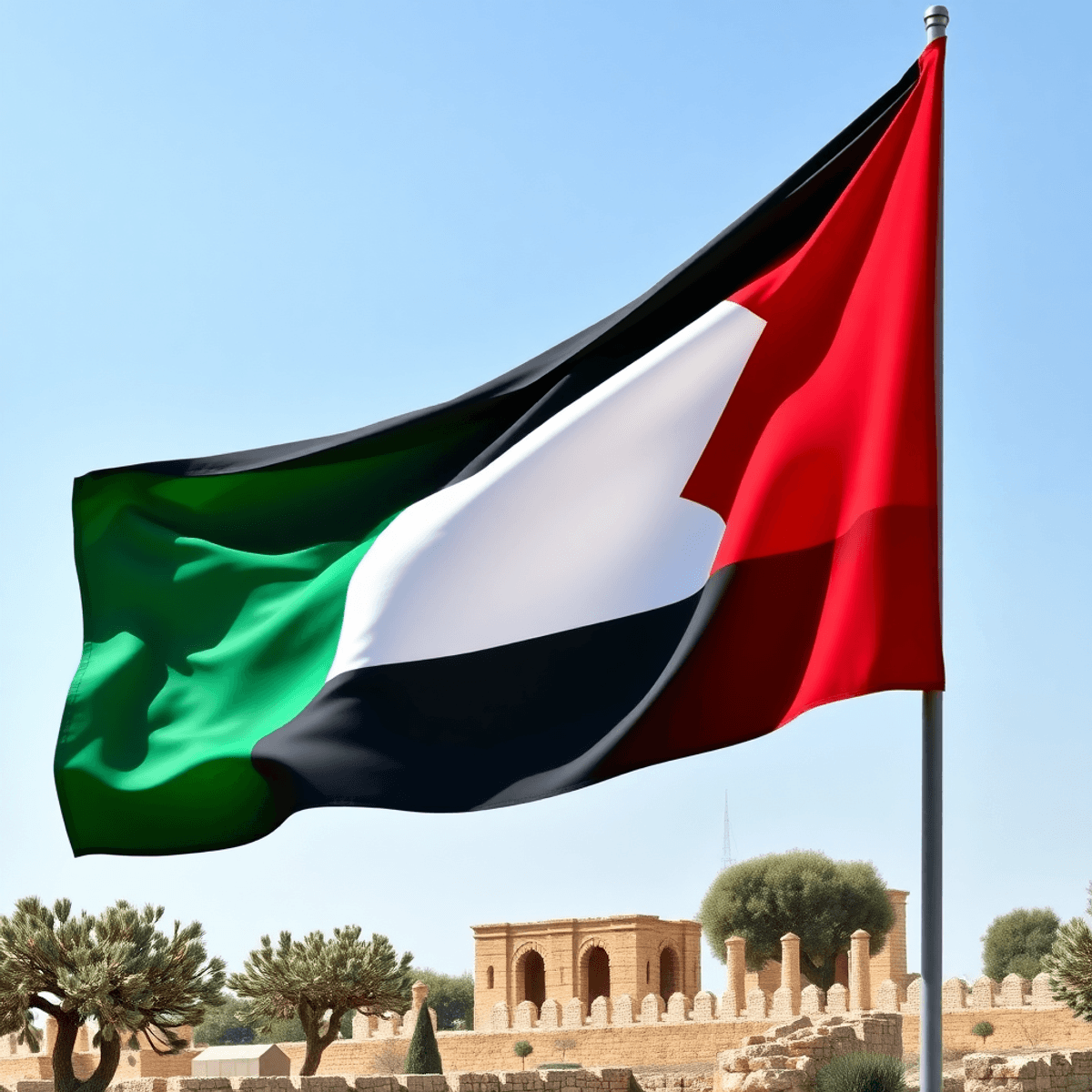
In May 1964, delegates from all over the Arab world gathered in East Jerusalem for an important meeting. During the event, a new banner was revealed for the first time—featuring horizontal stripes of black, white, and green with a prominent red triangle on one side. This Palestinian Liberation Organization flag signified the beginning of a movement that would significantly impact Middle Eastern politics for many years.
The PLO flag represents more than just a piece of fabric. It embodies a powerful political symbol deeply connected to centuries of Arab history and the ongoing fight for Palestinian self-determination. In this article, we will explore the significance of the PLO flag, including its political meaning, connections to pan-Arabism, and its role in the larger Palestinian struggle for statehood and global recognition.
Can a flag truly bring together a scattered people? Can the arrangement of colors on a piece of cloth have the ability to validate political movements internationally? The story of how the PLO flag evolved from being a symbol of revolution to becoming an accepted representation of Palestinian identity provides intriguing answers to these inquiries.
Historical Origins of the Palestinian Liberation Organization Flag
On May 28, 1964, delegates gathered in East Jerusalem for the first Palestinian National Council meeting witnessed a historic moment: the formal adoption of the Palestinian Liberation Organization flag. This date marked not just the birth of a new political entity but the crystallization of decades of Arab nationalist sentiment into a single, unified symbol. The timing was deliberate—the flag and the organization emerged together as inseparable elements of Palestinian political identity.

The Significance of Pan-Arab Colors
The pan-Arab colors displayed on the PLO flag—black, white, green, and red—carried a legacy stretching back far beyond 1964. These hues had already appeared in various combinations across the Arab world since the early 20th century, representing a shared vision of Arab unity and independence. The Arab Revolt of 1916-1918 against Ottoman rule first brought these colors together in a revolutionary context, creating a visual language that would resonate across generations.
Sir Mark Sykes and the Standardization of Colors
British diplomat Sir Mark Sykes played an unexpected role in cementing these colors as symbols of Arab nationalism. During World War I, Sykes worked to encourage Arab unity against the Ottoman Empire, recognizing that a unified visual identity could strengthen the movement. His efforts helped standardize the four colors as representations of Arab heritage, though their meanings predated his involvement.
Historical Connections Behind Each Color
Each color connected to powerful Arab dynasties that had shaped Islamic civilization:
- Black: The Abbasid Caliphate (750-1258 CE), centered in Baghdad
- White: The Umayyad Caliphate (661-750 CE), based in Damascus
- Green: The Fatimid Caliphate (909-1171 CE), ruling from Cairo
- Red: The Hashemite dynasty, descendants of Prophet Muhammad’s family
These historical connections transformed the PLO flag symbolism from simple decoration into a declaration of continuity with Arab political and cultural achievements spanning thirteen centuries. To understand more about how to read and interpret flags, including decoding their colors and shapes which reveal rich cultural and historical stories, you may find this guide useful.
Symbolism Behind Each Color in the PLO Flag
The PLO flag symbolism operates on multiple levels, with each of the pan-Arab colors carrying distinct historical and emotional weight. These colors don’t merely represent abstract concepts—they connect Palestinian identity to centuries of Arab history and Islamic heritage.
Black: Mourning and Remembrance
Black, positioned as a horizontal stripe at the top of the flag, traces its lineage to the Abbasid Caliphate (750-1258 CE), which ruled from Baghdad during Islam’s golden age. This color evokes themes of mourning and remembrance, particularly for lost territories and displaced peoples. In Palestinian context, black acknowledges the ongoing grief for homeland and the sacrifices made throughout decades of conflict. Historical records from the Smithsonian Institution’s collections note that black banners were traditionally raised during periods of resistance and defiance.
White: Purity and Hope
White, forming the middle horizontal band, represents the Umayyad dynasty (661-750 CE) that governed from Damascus. Islamic historical texts link white to purity and the Prophet Mohammed’s banner at the Battle of Badr in 624 CE, Islam’s first major military victory. This color embodies hope and the righteousness of the Palestinian cause.
Green: Fertility and Renewal
Green, the bottom horizontal stripe, connects to the Fatimid Caliphate (909-1171 CE) and symbolizes allegiance to Ali ibn Abi Talib, the Prophet Mohammed’s cousin and son-in-law. This color holds special significance in Islamic tradition as the color of paradise and renewal. University research from Georgetown’s Center for Contemporary Arab Studies identifies green as representing the fertile lands Palestinians seek to reclaim.
Red: Bloodshed and Sacrifice
Red, displayed in the triangular hoist, honors the Hashemite dynasty and their leadership during the Arab Revolt. This color speaks directly to bloodshed—the sacrifices of martyrs and the ongoing struggle for liberation. The red triangle points toward the future, suggesting forward momentum in the quest for statehood.
Political Context and Evolution of the PLO Flag’s Meaning
The Palestinian Liberation Organization (PLO) was established on May 28, 1964, during the Arab League Summit in Jerusalem. Its main goal was to create an independent Palestinian state throughout all of former Mandatory Palestine. The founding charter of the organization clearly rejected Israel’s legitimacy, positioning the PLO as a coalition that brought together various Palestinian groups under a unified front of armed resistance. The flag that was adopted on that same day served as a visual declaration of these political objectives, with its Pan-Arab colors symbolizing the connection between Palestinian aspirations and broader Arab nationalist goals.
Transformation of the Flag’s Meaning
As the PLO’s international standing evolved over the years, the meaning of its flag also underwent significant changes.
Recognition by Arab States
After the Rabat Summit in 1974, Arab countries recognized the PLO as the “sole legitimate representative of the Palestinian people,” giving the organization unprecedented diplomatic power. This recognition marked a crucial turning point: the flag that was once primarily seen at guerrilla training camps and military operations began to be displayed in United Nations meetings and international diplomatic discussions. Yasser Arafat’s speech to the UN General Assembly in 1974, where he famously declared he carried “an olive branch and a freedom fighter’s gun,” solidified this dual identity—the PLO flag now symbolized both armed resistance and diplomatic ambition.

יורם שורק licensed under Attribution-Share Alike 4.0 International license.
Symbol of Palestinian National Identity
The flag evolved beyond its original purpose as an emblem for the organization and became a living symbol of Palestinian national identity itself. During the First Intifada (1987-1993), Palestinians risked arrest by Israeli authorities simply for displaying the colors of the flag, turning raising it into an act of civil disobedience. The Oslo Accords period saw the flag gain semi-official status, flying alongside Israeli flags at negotiation tables and eventually over Palestinian Authority buildings in Gaza and the West Bank.
Comparing the Palestinian Liberation Organization Flag with Other Flags Representing Palestinian Identity
At first glance, the Palestinian flag and the PLO flag appear nearly identical. Both display the same Pan-Arab colors arranged in horizontal stripes of black, white, and green, with a red triangle extending from the hoist. This article examines the flag of the Palestinian Liberation Organization (PLO) alongside the Palestinian national flag to reveal how seemingly identical designs carry distinct political meanings.
The key difference lies not in design but in what each flag represents institutionally. The PLO flag specifically symbolizes the organization founded in 1964 as an umbrella coalition of various Palestinian resistance groups. The Palestinian national flag, while sharing the same design, represents Palestinian statehood and the broader Palestinian people as a nation, regardless of organizational affiliation. This distinction becomes particularly significant when examining Palestinian flag vs PLO flag usage in different contexts.
Design Elements and Shared Symbolism:
- Both flags use identical Pan-Arab color schemes
- Horizontal stripes maintain the same proportions
- Red triangles occupy equal space on both designs
- Neither flag includes text, emblems, or additional symbols
The Palestinian statehood symbolism embedded in the national flag gained prominence after the Palestinian Declaration of Independence in 1988, when the Palestinian National Council formally adopted it as the flag of the State of Palestine. Diplomatic missions, United Nations appearances, and official state functions typically display the Palestinian national flag, emphasizing sovereignty claims. The PLO flag appears more frequently in contexts highlighting the organization’s historical role in liberation efforts, particularly during commemorations of the organization’s founding or events celebrating resistance movements.
Public perception often blurs these distinctions, with many using the terms interchangeably. Protesters worldwide wave what they call the “Palestinian flag” without distinguishing between organizational and national identity. Such scenarios are reminiscent of how rebel flags, like those used during uprisings and underground movements, can symbolize defiance and revolution across centuries.
The Role of Pan-Arab Colors in Middle East Politics Beyond Palestine
The pan-Arab colors extend far beyond Palestinian symbolism, appearing prominently across the flags of Jordan, Syria, Iraq, Sudan, Yemen, and the United Arab Emirates. This widespread adoption reflects a shared vision that emerged during the early 20th century Arab Revolt against Ottoman rule. When Sharif Hussein ibn Ali raised the Arab Revolt flag in 1916, he established a visual language that would resonate across the region for generations.
The Significance of Pan-Arab Colors in National Flags
- Jordan’s Flag: Incorporates all four colors with a distinctive seven-pointed star representing the opening verses of the Quran.
- Syria’s Flag: Arranges the colors in horizontal bands with two green stars symbolizing the former union with Egypt.
- Iraq’s Flag: Evolved through multiple political transitions, yet consistently retained the pan-Arab roots that connect it to broader regional identity.
These flags don’t merely share aesthetic elements—they declare political kinship and historical solidarity.
The Impact of Shared Symbols on Regional Politics
The influence of these shared symbols on regional politics has been substantial. During the 1950s and 1960s, the pan-Arab nationalist movement led by Egypt’s Gamal Abdel Nasser used these colors to promote unity projects like the United Arab Republic. The visual consistency across flags in Middle East politics reinforced the idea that artificial colonial borders shouldn’t divide Arab peoples. Even today, these symbols shape diplomatic relationships and public sentiment during regional conflicts.
The PLO’s Strategic Use of Pan-Arab Colors
The PLO’s adoption of pan-Arab colors strategically positioned the Palestinian cause within this larger narrative of Arab nationalism. By embracing these widely recognized symbols, the organization signaled that Palestinian liberation wasn’t an isolated struggle but part of the broader Arab fight against colonialism and foreign domination. The flag simultaneously asserted Palestinian distinctiveness while claiming membership in the Arab family of nations, creating a powerful dual identity that resonated across borders.
The Flag: A Tool for International Recognition and Diplomacy
The Palestinian Liberation Organization (PLO) flag has done more than just represent resistance—it has also been used as a diplomatic tool on the global stage.
A Historic Moment at the UN
When Yasser Arafat spoke at the United Nations General Assembly on November 13, 1974, he wore a traditional Arab scarf and had a gun holster by his side. But it was the PLO flag behind him that truly conveyed the message of Palestinian hopes for an independent state. This was a significant occasion as it marked the first time the UN allowed a non-state entity to have observer status, enabling the PLO flag to be displayed alongside those of recognized countries.
The Power of Visual Symbols in Diplomacy
In international relations, visual symbols hold great significance. The presence of the Palestinian Liberation Organization flag at diplomatic events turns abstract political claims into concrete assertions of sovereignty. Every time the flag is shown at UN meetings, peace talks, or global conferences, it reinforces the Palestinian narrative of self-determination. By displaying the flag in such settings, Palestinians seek to challenge traditional notions of statehood recognition and establish visual parity with acknowledged nations.
Building Connections with Global Supporters
The PLO flag has also helped forge connections with supporters worldwide who view the Palestinian struggle as part of a broader fight against colonialism. Its colors, representing Pan-Arab unity, resonate with countries that have undergone similar battles for independence, fostering symbolic solidarity across different regions. Protests by students, marches in support of Palestine, and advocacy campaigns around the world have embraced the PLO flag as a powerful symbol representing their endorsement for Palestinian statehood.
Limitations of Symbolic Power
However, despite its symbolic significance and presence in international forums since 1974, the PLO flag alone cannot secure full membership for Palestine in the United Nations. This disconnect between symbolic recognition and actual political status highlights the limitations of using visual diplomacy as a means to achieve tangible outcomes.
While displaying the PLO flag may open doors for dialogue on an international level, it cannot overcome existing geopolitical barriers or resolve fundamental disagreements regarding borders, security issues, and questions surrounding sovereignty that continue to shape the Israeli-Palestinian conflict.
The PLO Flag’s Continued Importance in Palestinian Identity and Resistance Today
The Palestinian Liberation Organization flag remains a vibrant symbol in contemporary Palestinian life, visible in various settings such as street protests in Ramallah and solidarity marches across cities like London, Berlin, and New York. Young Palestinians proudly wear the flag’s Pan-Arab colors during demonstrations against settlement expansion, while diaspora communities display it at cultural festivals that showcase Palestinian heritage through music, poetry, and traditional dance. Social media platforms play a significant role in amplifying its visibility—activists superimpose the flag on their profile pictures, artists incorporate its colors into digital artwork, and journalists capture images of it being waved above crowds demanding justice.
Different Meanings of the PLO Flag Across Generations
The symbolism behind the PLO flag holds varying significance for different generations. Older Palestinians who witnessed the organization’s establishment often perceive the banner as a representation of years of armed resistance and diplomatic efforts. On the other hand, their children and grandchildren, who were born during the Oslo Accords period or grew up during the Second Intifada, sometimes question whether traditional symbols truly encompass their lived experiences under occupation or in refugee camps. Nevertheless, the flag endures as a unifying symbol during times of crisis—whenever violence erupts in Gaza or tensions escalate at Al-Aqsa Mosque, Palestinians worldwide come together under these four colors.
Palestinian scholar Rashid Khalidi emphasizes that flags act as “portable homelands” for stateless individuals, carrying emotional significance beyond their physical presence. Activist groups such as Palestinian Youth Movement embrace the flag while incorporating modern messages about climate justice and intersectional solidarity. Street artists in Bethlehem and Jenin reinterpret its colors in murals depicting icons of resistance alongside contemporary struggles. This adaptability showcases how symbols can evolve without losing their fundamental identity—serving as a testament to their ability to unite communities separated by borders, generations, and geographical locations.
Conclusion
The Palestinian Liberation Organization flag represents more than just a piece of fabric—it embodies years of struggle, identity, and unwavering hope. With its pan-Arab origins and carefully selected symbols, this emblem connects Palestinian national goals to wider Arab unity movements while asserting a unique political voice globally.
PLO flag symbolism is still present in protests from Ramallah to refugee camps around the world, reminding us that symbols play a significant role in shaping political awareness. Each color tells a story of empires, conflicts, and the ongoing fight for self-determination that defines the Palestinian experience.
Understanding the histories behind flags like the PLO’s provides valuable insight into current conflicts. These symbols aren’t separate—they come from specific historical events, change through political shifts, and remain as symbols for communities seeking recognition and justice. The flag’s journey from its 1964 introduction to today’s diplomatic discussions and street protests shows how visual symbols become intertwined with the movements they represent, carrying on the hopes of generations who continue their fight for statehood and global acceptance.