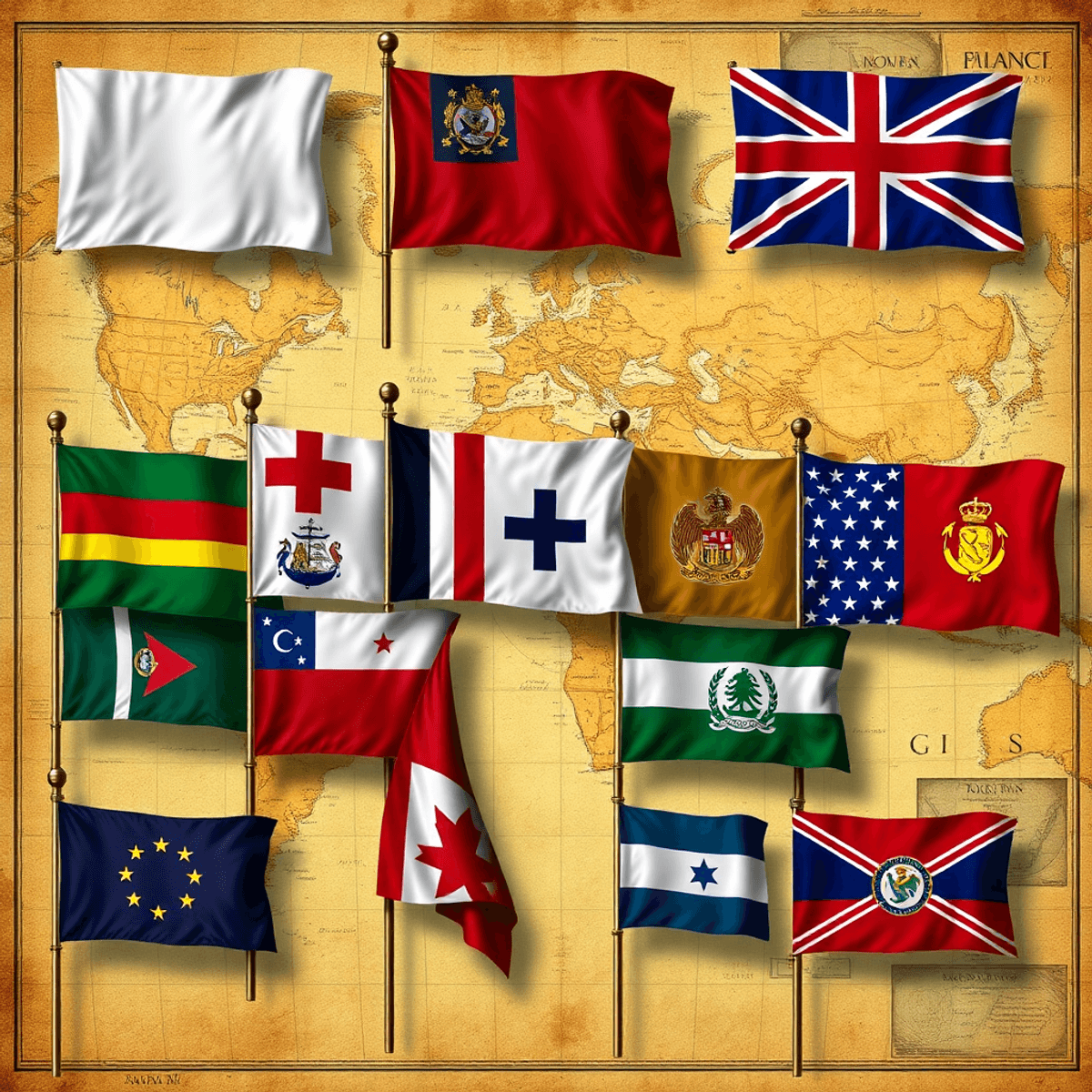
The French Colonial Empire stretched across three continents, encompassing territories from the Caribbean to Southeast Asia between the 16th and 20th centuries. At its height in the 1920s, it spanned over 12.5 million square kilometers—second only to the British Empire. Throughout this vast domain, the French colonial flag flew as a symbol of authority, cultural influence, and imperial ambition, marking France’s presence in far-reaching corners of the world.
The Role of Flags in the French Colonial Empire
Flags played a crucial role in this vast colonial network. They served as powerful visual declarations of French sovereignty, marking administrative buildings, ships, and official ceremonies throughout the colonies. The strategic placement of these flags transformed local landscapes into symbols of French authority.
The Philosophy Behind French Colonial Flag Design
The French approach to colonial flag design reflected a distinct philosophy of imperial governance. While Britain’s colonies uniformly displayed the Union Jack in the canton position, French colonial flags often incorporated the tricolor alongside indigenous symbols. This design choice illustrated France’s “mission civilisatrice” – a policy that aimed to spread French culture while acknowledging local identities.

The Dual Nature of Colonial Flags
Colonial flags became potent symbols of both power and resistance. In government buildings, they represented French authority. In the hands of independence movements, modified versions of these same flags became rallying points for anti-colonial sentiment.
Historical Collections
- Library of Congress Flag Collection
- Smithsonian National Museum of American History
- French National Archives Colonial Records
- Maritime Museums of France
These preserved flags offer valuable insights into France’s colonial relationships and the complex interplay between imperial power and local identity.
Design Elements of French Colonial Flags
The French national flag, known as the tricolore, features three vertical stripes of blue, white, and red. Born from the French Revolution, these colors symbolize:
- Blue: Liberty, democracy
- White: Equality, peace
- Red: Fraternity, valor
Placement of the Tricolor
The tricolor’s placement in colonial flags followed a distinct pattern. Most French colonial territories displayed the tricolor in the canton—the upper left corner of the flag. This design choice served as a visual reminder of the connection to metropolitan France while allowing space for local symbolism in the remaining field.
Political Significance of the Tricolor
The incorporation of the tricolor in colonial flags carried deep political significance. The revolutionary ideals embedded in these colors—liberty, equality, fraternity—projected France’s civilizing mission across its empire. This visual language created a unified imperial identity while acknowledging the distinctiveness of each territory.
Examples of Flag Designs
Several colonies demonstrated this design principle:
- French West Africa: Blue field with tricolor canton
- French Equatorial Africa: Green field with tricolor canton
- French Polynesia: Red and white stripes with tricolor canton
- New Caledonia: Green and red diagonal with tricolor canton
These designs established a clear visual hierarchy: the tricolor’s prominent position asserted French sovereignty while the remaining field expressed local character through colors and symbols significant to each region. Such insights into the evolution of flag design, including the symbolism and history behind them, can greatly enhance our understanding of these flags’ significance and their role in representing both French authority and local identity.
Regional Adaptations: Local Symbols Meet the French Flag
The French colonial government was skilled at blending cultures through flag design. They created unique identities for each territory while still asserting French control. This approach varied in different areas:
1. French Indochina (Laos)
The flag of the Kingdom of Luang Prabang showcased a vibrant red background with a prominent white three-headed elephant symbol. The French tricolor was positioned in the corner, combining Laotian royal imagery with French colonial power.
2. Syrian Mandate Variations
During the French Mandate of Syria, several flag designs emerged that incorporated Middle Eastern symbols:
- Damascus State: Green field with tricolor canton
- Aleppo State: White field with stars
- Alawite State: Yellow field with four red stars
3. Lebanese Cedar Integration
Lebanon’s mandate flag exemplifies symbolic integration. The traditional green cedar tree, representing centuries of Lebanese heritage, was placed within the white stripe of the French tricolor. This design visually represented Franco-Lebanese cooperation.
4. Pacific Territory Adaptations
Wallis and Futuna developed an unofficial design featuring:
- Red background field
- Four white triangles arranged in square formation
- French tricolor positioned in canton
- Traditional Polynesian symbols integrated into the layout
These regional adaptations served two purposes: they acknowledged local cultural heritage while reinforcing French administrative presence through consistent tricolor placement.
Flags of Authority: Special Flags for Governors-General and Officials in Colonies
The French Colonial Empire established a sophisticated hierarchy of flags to denote authority and administrative power within its territories. These distinctive flags served as visual symbols of French governance and colonial administration.
Governor-General Flags
- Square-shaped blue field
- French tricolor ensign positioned in canton
- Flown beneath national ensign at official residences
- Reserved exclusively for highest colonial administrators
Colonial Governor Flags
- Rectangular swallow-tailed design
- Blue field with French ensign in canton
- Distinct shape differentiated from Governor-General flags
- Used during official ceremonies and government functions
The precise design specifications of these flags reflected the strict administrative hierarchy within the colonial system. Governor-General flags represented supreme colonial authority, while the swallow-tailed variants identified regional governors with more limited jurisdictions.
Historical records from the French National Archives reveal these flags flew at:
- Government buildings
- Military installations
- Official ceremonies
- Diplomatic functions
- Colonial administrative offices
The careful regulation of these authority flags created a visual language of power across the empire. Their presence reminded colonial subjects of French sovereignty while providing colonial officials with recognizable symbols of their administrative authority.
These authority flags remained largely unchanged throughout the colonial period, providing consistency in colonial governance symbolism from the Caribbean to Indochina. The French National Archives preserve several original examples, documenting their use in various colonial territories.

Unofficial and Proposed Flags Within the Empire
The French Colonial Empire witnessed numerous unofficial flag proposals that never received formal recognition. These designs reflected complex political dynamics and evolving relationships between France and its colonies.
Tunisia’s proposed civil ensign serves as a prime example of these unofficial variations. The design incorporated the French tricolor in the canton while maintaining the traditional red field with white disk and star. This creative fusion attempted to balance colonial authority with local identity, yet remained unofficial throughout Tunisia’s protectorate status.
Other notable unofficial designs included:
- Madagascar’s Regional Proposals – Various districts developed unique flag combinations featuring local symbols alongside the tricolor
- New Caledonia’s Early Attempts – Multiple designs emerged incorporating indigenous Kanak patterns with French elements
- Cochinchina’s Merchant Flag – A yellow field with red border and tricolor canton, used informally by local traders
These unofficial flags often emerged from practical needs or political aspirations within colonial territories. Local administrators and merchants sometimes created their own variants to distinguish their services or assert regional identity while maintaining connections to metropolitan France.
Many proposed designs originated from colonial councils seeking greater autonomy or recognition. These flags represented experiments in visual sovereignty – attempts to carve out distinct identities while acknowledging French authority through careful incorporation of the tricolor.
The Enduring Legacy of French Colonial Flags Today
The influence of French colonial flags lives on through modern territorial emblems. French overseas territories (départements et régions d’outre-mer) maintain distinctive flags that blend historical colonial designs with contemporary symbolism.
Current Territorial Flag Examples:
- Martinique’s flag incorporates the snake-and-cross design with elements of the tricolor
- New Caledonia uses both the French flag and the Kanak flag, representing dual heritage
- French Polynesia’s flag features a traditional outrigger canoe alongside red-white stripes
These modern adaptations serve as bridges between colonial history and present-day identity. Local communities actively engage with these symbols through cultural festivals, government buildings, and public spaces.
Several museums preserve and showcase original French colonial flags:
- Musée de l’Armée in Paris houses an extensive collection of military and colonial flags
- Archives Nationales d’Outre-mer in Aix-en-provence maintains historical flag documentation
- Musée du Quai Branly features colonial artifacts including ceremonial flags
Regional heritage centers across former French territories display replicas and educational exhibits about colonial flags. These installations highlight the complex relationship between imperial power and local autonomy through vexillological evolution, as detailed in this Flagmaster Index.
The preservation of these flags provides valuable insights into French colonial administration and its lasting impact on territorial identities. Modern historians and cultural institutions continue to study these emblems as windows into colonial relationships and power dynamics.
Conclusion
The flags of the French Colonial Empire are significant artifacts that represent a complex period in history. These symbols were carefully designed to combine French national identity with regional cultural elements, resulting in unique visual representations of colonial relationships and power dynamics.
The evolution of these flags—from the simple addition of the tricolor canton to intricate combinations with local emblems—shows the delicate balance between imperial authority and colonial identity. Their lasting influence can be seen in modern territorial flags and museum collections worldwide.
What stories do these colonial flags tell us about the relationship between symbols, power, and cultural identity?
Readers interested in exploring this fascinating connection between flag study and colonial history can find valuable resources in national archives, military museums, and academic institutions dedicated to preserving these important historical artifacts.