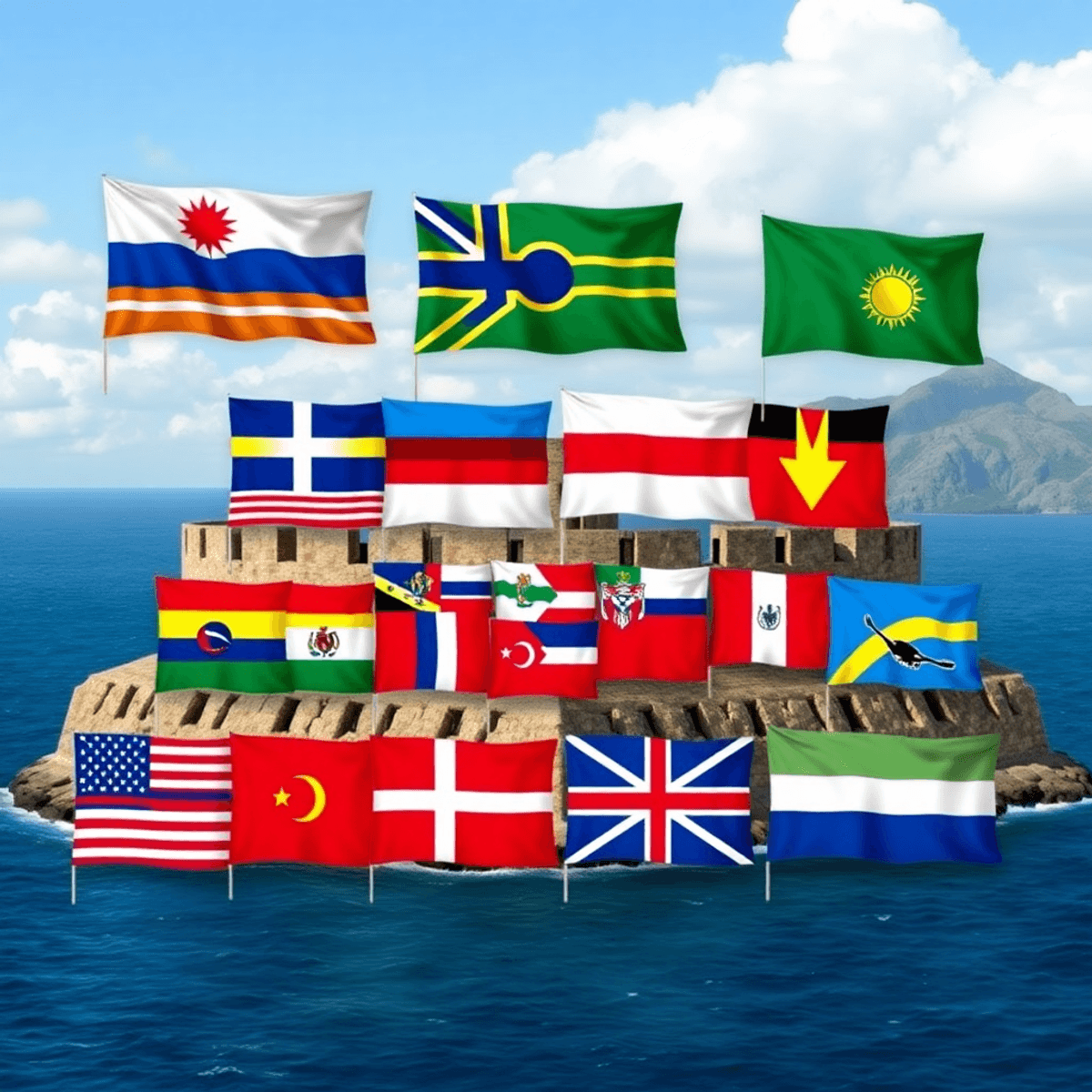
In the North Sea, there is a unique independent state located on a World War II naval fort. This place is known as the Principality of Sealand, and it has a flag that resembles those found in fictional country flags.
Sealand is one of the most intriguing micronations in the world.
This small nation, covering an area of 120 square meters, was once an abandoned military site. However, it has now declared itself an independent state. The flag of Sealand, with its red and black diagonal stripes and white corner, proudly flies above the sturdy structure made of steel and concrete. It represents the fearless nature of its founders.
What began as a location for pirate radio broadcasts in the 1960s has evolved into an extraordinary experiment in micro-sovereignty. The tale of Sealand is filled with excitement: armed confrontations, failed attempts at overthrowing the government, and a royal family that came into existence not through ancient lineage but through sheer boldness.
Imagine a tiny nation where you can become a noble by making online purchases, where skateboarding competitions take place on a former military fort, and where a single family holds onto their claim of independence through unwavering determination and cleverness.
The Origins of Sealand
HM Fort Roughs was built during World War II as part of Britain’s defense strategy. Constructed in 1942, it was one of the Maunsell Sea Forts designed to protect important shipping routes between England and mainland Europe. This unique structure, made of steel and concrete, had a rectangular platform supported by two hollow concrete towers that rose 18 meters above the sea.

Military Purpose
The British military stationed personnel at Fort Roughs to carry out various defense operations:
- Anti-Aircraft Defense: Soldiers at the fort operated anti-aircraft weapons to defend against enemy planes.
- Radar Surveillance: Radar equipment installed on the fort allowed for early detection of approaching aircraft and ships.
- Protection of Merchant Vessels: The primary mission was to safeguard merchant vessels from attacks by German planes and submarines.
The fort could accommodate up to 300 service members who lived in cramped living quarters above the turbulent North Sea.
Decline and Abandonment
After the war, HM Fort Roughs fell into disuse. By 1956, the last military personnel left the fort, leaving it abandoned and vulnerable to weather conditions. It seemed like this isolated outpost would be forgotten if not for an enterprising former British Army major named Paddy Roy Bates.
The Rise of Sealand
In 1966, Bates took over the deserted platform, initially using it as a base for his pirate radio station. His audacious action turned the neglected military fort into something entirely new—an independent sovereign state. On September 2, 1967, Bates proclaimed the platform as the Principality of Sealand, appointing himself as Prince Roy and his wife Joan as Princess Joan.
From Pirate Radio to Sovereign State
Radio Essex marked the beginning of Sealand’s transformation from an abandoned military fort to a self-proclaimed sovereign nation. In 1966, Paddy Roy Bates established this pirate radio station on HM Fort Roughs, broadcasting rock music and commercial content beyond British territorial waters to bypass strict broadcasting regulations.
The station’s rebellious spirit laid the groundwork for Sealand’s identity. Operating outside conventional boundaries, Radio Essex attracted a dedicated following who tuned in for its unrestricted programming and bold defiance of traditional broadcasting norms.
The Transition from Pirate Radio to Sovereign State
The transition from pirate radio to sovereign state occurred on September 2, 1967, when Bates declared the platform’s independence. This bold move reflected the same maverick attitude that characterized the pirate radio era:
- Creation of national symbols including a flag, constitution, and anthem
- Establishment of a royal family structure with Bates as Prince
- Development of unique governmental systems
- Introduction of Sealand’s own currency and passports
The Impact of Pirate Radio Legacy on Sealand
The pirate radio legacy shaped Sealand’s cultural DNA, fostering:
- A spirit of independence and self-determination
- Resistance to external control
- Innovation in communication and broadcasting
- A tradition of challenging conventional authority
This rebellious heritage continues to influence Sealand’s modern identity, as the micronation maintains its position as a symbol of sovereignty and independence in international waters.
Navigating Jurisdictional Challenges
The Principality of Sealand’s claims to sovereignty exist in a complicated legal situation. A crucial UK court ruling in 1968 set an unexpected precedent when British authorities decided not to prosecute a firearms incident near the platform, stating that Sealand was outside their jurisdiction.
This legal uncertainty changed dramatically in 1987 when the UK expanded its territorial waters from 3 to 12 nautical miles. The expansion technically brought Sealand under British jurisdiction, but the micronation continued to assert its claims of independence based on the earlier court decision and established rights of occupation.
Diplomatic Interactions and Recognition
A significant test of Sealand’s sovereignty occurred through diplomatic interactions with Germany in 1978. After Dutch and German mercenaries attempted a coup by kidnapping Prince Michael Bates, German diplomats engaged in direct negotiations for their release. This diplomatic exchange unintentionally granted Sealand a form of de facto recognition.
Practical Challenges Arising from Legal Ambiguity
The platform’s unique legal situation has created several practical challenges:
- Passport Recognition: While Sealand issues its own passports, no major nation officially accepts them
- Economic Activities: Legal uncertainties affect business ventures and financial operations
- Maritime Law Applications: Questions persist about which maritime laws apply in Sealand’s waters
- International Relations: The micronation operates without formal diplomatic recognition
Despite these jurisdictional obstacles, Sealand continues to assert its independence through self-governance structures and maintains its position as a sovereign entity separate from the United Kingdom.
Defending Against Invasions and Coup Attempts
The history of Sealand includes intense armed conflicts that challenged its claims to independence. In late 1968, Roy Bates and his son Michael fought off rival radio pirates who tried to take over their platform. Using petrol bombs and guns, the Bates family successfully drove away the attackers.

The 1978 Coup Attempt
A more serious threat arose in 1978 when German and Dutch mercenaries made a well-planned attempt to overthrow the Bates family. The attackers managed to capture Prince Michael Bates and held him hostage in the Netherlands. In response, Prince Roy organized a bold counter-attack, using helicopters to retake the platform. This operation showcased the family’s determination to defend their claimed territory.
Security Measures Implemented by the Bates Family
To ensure the safety of Sealand, the Bates family established a permanent armed presence on the platform with various security measures in place:
- 24-hour guard rotations
- Weapons caches strategically placed around the platform
- Emergency response protocols
- Surveillance systems monitoring approaching vessels
These security measures, akin to some NATO military strategies, proved effective – no subsequent invasion attempts succeeded. The platform’s isolated location and elevated position provided natural defensive advantages, while the family’s military background informed their tactical approach to security.
Moreover, they implemented advanced security controls that further enhanced their defense capabilities. The successful defense against these armed attacks reinforced Sealand’s claim of independence and showcased the Bates family’s commitment to safeguarding their micronation through direct action.
The Eccentric Royal Family and Unique Culture of Sealand
The Bates family brings a distinctive flair to their royal duties, embracing their roles with a mix of serious dedication and playful eccentricity. Prince Roy Bates, the founding father, styled himself as “Prince Roy” while his wife Joan became “Princess Joan” – creating a royal lineage that continues with their son Michael, now Prince Regent of Sealand.
The micronation’s culture reflects this blend of traditional monarchy and modern innovation. Sealand has developed unique traditions and cultural elements:
- Noble Titles Program: Citizens can purchase authentic Sealand nobility titles, becoming Lords, Ladies, Barons, or Baronesses
- Sports Initiatives: The nation fields its own football team, American football club, and national athletics program
The royal family has also established distinctive national symbols:
- A national anthem titled “E Mare Libertas”
- Official Sealand dollars minted in gold and silver
- Customized passports and stamps
The platform’s limited space hasn’t stopped the Bates family from hosting creative events, including:
- Skateboarding competitions
- Half-marathons around the fort’s deck
- Royal ceremonies and celebrations
These cultural elements create a unique identity that sets Sealand apart from other micronations, blending ceremonial tradition with modern entertainment and sport.
Modern Innovations, Sustainability Efforts, and Symbolic Sovereignty Assertion in Sealand
The Principality of Sealand has embraced technological advancement while maintaining its commitment to environmental sustainability. The micronation’s governance system now incorporates Web3 tools, enabling transparent decision-making processes and community participation across borders.
Sealand’s dedication to environmental stewardship is evident through its renewable energy initiatives:
- Solar Panel Array: Installed across the fort’s upper deck
- Wind Turbines: Strategically placed to harness North Sea winds
- Energy Storage Systems: Supporting 24/7 power availability
These green energy solutions now generate nearly 95% of Sealand’s electricity needs, marking a significant step toward energy independence.
The micronation’s self-governance structure operates through a unique blend of traditional and modern approaches. A digital citizenship program allows supporters worldwide to participate in Sealand’s affairs while maintaining the physical presence that underpins its sovereignty claims.
Key governance elements include:
- Digital voting systems for major decisions
- Blockchain-based record-keeping
- Virtual administrative offices
- Remote participation in cultural events
The platform’s continuous occupation remains crucial to Sealand’s sovereignty claims. A rotating staff maintains the fort’s operations, ensuring uninterrupted presence despite challenging North Sea conditions. This commitment to physical presence, combined with technological innovation, reinforces Sealand’s position as a forward-thinking micronation adapting to 21st-century challenges.
The Enduring Legacy of the Principality of Sealand’s Flag
The red, white, and black flag of Sealand stands as a testament to human ingenuity and the quest for sovereignty. This bold emblem represents a remarkable story of determination, from its pirate radio roots to its current status as a self-proclaimed independent nation.
The flag continues to fly proudly atop HM Fort Roughs, symbolizing:
- A unique experiment in micro-nationalism
- The spirit of independence and self-governance
- A bridge between wartime history and modern innovation
- The endurance of the Bates family’s vision
Sealand’s story captivates minds worldwide, inspiring discussions about sovereignty, international law, and the meaning of nationhood. Its flag serves as an invitation to explore this fascinating chapter of maritime history.
The colors and design of the flag are not just random choices; they hold deep meanings and reflect the values and aspirations of the Principality. If you’re interested in understanding more about how to read a flag by decoding their colors, shapes, and symbols, which can reveal rich cultural and historical stories, you might find this guide on how to read a flag helpful.
Additionally, Sealand’s flag could be compared or contrasted with other flags that symbolize lost civilizations or ancient myths. For an intriguing exploration into the imagined flags of mythical realms like Atlantis or Hyperborea, check out this article on mythical flags.
Ready to dive deeper into Sealand’s story? Visit the official Principality of Sealand website to discover noble titles, commemorative coins, and historical documents that bring this extraordinary micronation to life. The platform’s legacy lives on through its dedicated community, innovative governance, and unwavering commitment to independence.