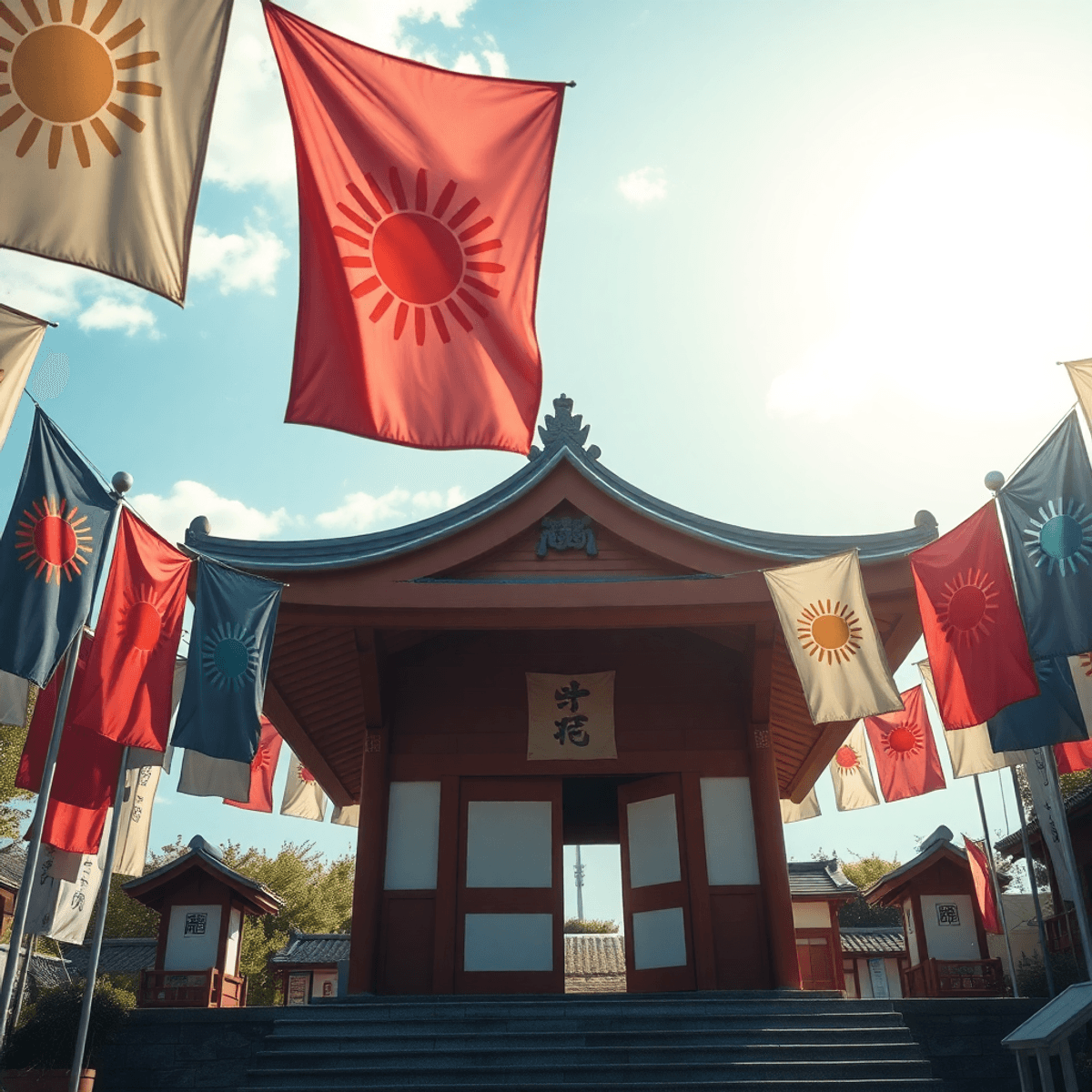
Imagine standing in front of a magnificent Shinto shrine in Japan during the 1930s. Colorful flags wave in the wind, displaying sacred symbols that shimmer in the sunlight—sun discs, intricately designed mirrors, and bold characters proclaiming divine authority. These flags were not just for decoration; they held a deeper meaning: the blend of ancient spirituality and contemporary political power.
Shinto shrine flags had two main functions throughout the history of Imperial Japan. Firstly, as religious symbols, they indicated holy places where kami (deities) resided, providing spiritual protection to worshippers. This aspect of the flags aligns with the broader narrative of lost indigenous flags, which often carry sacred symbols and deep cultural and spiritual meanings.
Secondly, these flags were used as political tools to promote loyalty to the empire and stir up nationalist enthusiasm, especially during the militaristic period leading up to World War II. The use of these flags as state propaganda is similar to historical theocratic flags, where spiritual authority and national identity come together, representing divine power and political rule.
This article explores the flags associated with Shinto shrines during Imperial Japan. It delves into their religious significance, how they were manipulated for political purposes during wartime, and their enduring influence on Japanese culture and national identity. From their sacred beginnings rooted in indigenous belief systems to their contentious use as state propaganda, these flags narrate a story of how spiritual symbols can be repurposed as tools of political domination.
Understanding the History: Shinto Shrine Flags in Imperial Japan
Shinto, Japan’s indigenous spiritual tradition, centers on reverence for kami—divine spirits inhabiting natural phenomena, ancestors, and sacred places. Long before the modern era, this belief system shaped Japanese cultural identity through rituals, festivals, and shrine worship. [Shinto’s animistic worldview](https://www.britannica.com/topic/Shinto) emphasized harmony between humans and the spiritual realm, creating a framework where physical symbols like flags could embody divine presence.
The Meiji Restoration of 1868 transformed Shinto from a loosely organized collection of local practices into a centralized state apparatus. [Government reforms deliberately separated Shinto from Buddhism](https://www.ndl.go.jp/modern/e/cha4/description05.html), which had intermingled with indigenous beliefs for centuries. This article examines the flags used in and around Shinto shrines during Imperial Japan, revealing how these banners evolved from simple religious markers into instruments of national ideology.

The Role of Government in Shinto
The new government established a strict hierarchy of shrines under bureaucratic control. At the apex stood Ise Shrine, dedicated to Amaterasu-Ōmikami, the sun goddess from whom the imperial family claimed direct descent. [This organizational structure](https://www2.kokugakuin.ac.jp/ijcc/wp/cpjr/shinto/sh_1.html) reinforced the emperor’s divine status while standardizing religious practices across the archipelago.
The Significance of Shinto Shrine Flags
Shinto shrine flags became visual declarations of this system—each banner marking sacred space where kami dwelled and simultaneously affirming the connection between heavenly authority and earthly governance. Imperial Japan symbolism woven into these textiles transformed them into dual-purpose objects serving both spiritual devotion and political allegiance.
Religious Symbolism Embedded in Shinto Shrine Flags
Flags in Japanese religion served as visual prayers, their designs rich with sacred meaning. The most prominent motif was solar imagery—golden circles, radiating beams, and stylized representations of the sun goddess Amaterasu-Ōmikami. These designs transformed cloth into divine presence, reminding worshippers that the kami watched over them from celestial realms.
Shinto shrine flags frequently displayed the kagami (sacred mirror), one of the three imperial regalia. This symbol represented truth, wisdom, and the soul’s purity. When emblazoned on banners fluttering above shrine grounds, mirrors invited self-reflection and spiritual clarity. The torii gate—that distinctive vermillion archway marking the boundary between mundane and sacred space—also appeared on flags, signaling the threshold where human and divine worlds intersected.
Color choices carried weight:
- Red symbolized vitality and protection against evil spirits.
- White represented purity and sincerity.
- Gold evoked the sun’s life-giving power and imperial majesty.
These hues combined to create flags that didn’t merely decorate shrines but actively participated in spiritual work.
During matsuri (festivals), flags became animated participants in ritual drama. Priests carried them in processions, their movement through streets believed to spread divine blessings to the community. The fabric’s motion in wind suggested kami presence—invisible yet palpable. Worshippers bowed before these banners as they would before the shrine’s inner sanctum, recognizing flags as extensions of the deity’s sacred body.
Political Co-opting of Shrine Flags During Wartime Japan
The transformation of Shinto shrine flags from purely spiritual objects into instruments of state power began decades before World War II. The Meiji government initiated the Great Promulgation Campaign (1870-1884), deploying specially trained “National Evangelists” who traveled throughout Japan fusing religious devotion with political loyalty. These evangelists carried shrine flags bearing sacred symbols, reframing them as emblems of imperial authority and national destiny.
Militarization and Propaganda
As militarization intensified in the 1930s, wartime Japan iconography increasingly incorporated shrine flag motifs into propaganda materials. The government systematically leveraged these symbols to manufacture consent for aggressive expansion.
- Military parades featured massive shrine flags alongside the Rising Sun banner, creating visual associations between divine blessing and martial prowess.
- State ceremonies at major shrines became spectacles of Imperial Japan symbolism, with flags positioned to suggest the emperor’s divine mandate for war.
Education and Indoctrination
Public education campaigns distributed textbooks and posters depicting shrine flags as rallying icons for national unity. Children learned to associate the sun disc and torii gate imagery with patriotic duty and sacrifice.
- Schools conducted daily rituals before shrine flag replicas, conditioning young minds to equate religious reverence with obedience to military authority.
- The sacred symbols that once connected worshippers to kami now served as psychological tools binding citizens to the state’s wartime agenda.
Colonial Contexts: Shrine Flags Beyond Mainland Japan
The influence of Shinto shrine flags extended far beyond Japan’s borders during the empire’s territorial expansion. Between 1910 and 1945, Japanese colonial administrators established over 1,000 state-sponsored Shinto shrines across the Korean Peninsula, each displaying the distinctive flags and banners that had become synonymous with Imperial Japan symbolism. These shrines served as architectural manifestations of Japanese authority, their flags visible reminders of colonial power planted in conquered territories.
Diverging Meanings
Colonial shrine flags carried meanings that diverged sharply from their spiritual origins:
- While mainland Japanese citizens might view these cultural symbols of Japan as connections to divine protection,
- Korean subjects experienced them as markers of forced assimilation.
Policies and Practices
The Jinja Sanpai (shrine worship) policies compelled Koreans to participate in rituals beneath these flags, including bowing toward the imperial palace and reciting oaths of loyalty. School children marched to colonial shrines under the watchful gaze of flag-adorned torii gates, their attendance recorded and enforced.
Forms of Resistance
Resistance took various forms:
- Some Koreans refused shrine visits despite threats of imprisonment or loss of employment.
- Christian communities particularly opposed what they viewed as idolatry disguised as civic duty.
Contested Symbols
The flags themselves became contested symbols—what Japanese authorities framed as benevolent spiritual guidance, colonized peoples recognized as tools of cultural erasure. This tension revealed how shrine flags functioned as instruments of imperial expansionist ideology, their meaning transformed by the violence of colonial occupation.

Lasting Cultural Impact and Contemporary Debates on Shrine Flags
The cultural symbols of Japan carry weight that extends far beyond their aesthetic appeal. Shinto shrine flags remain visible throughout modern Japan, appearing at local festivals, national holidays, and religious ceremonies. Their presence sparks ongoing conversations about how contemporary society should interpret emblems once weaponized for imperial expansion.
The Complicated Legacy of Postwar Japan
Postwar Japan inherited a complicated legacy. The Allied Occupation (1945-1952) formally separated Shinto from state control, yet the visual language of shrine iconography persisted in public life. Flags bearing sun motifs, torii gate designs, and other traditional symbols continue decorating festival grounds and shrine precincts. Some Japanese citizens view these displays as harmless expressions of cultural heritage and religious tradition. Others recognize uncomfortable echoes of militaristic propaganda that mobilized millions toward war.
Ongoing Debates Among Scholars, Religious Leaders, and Politicians
Scholars, religious leaders, and politicians regularly debate where to draw lines between honoring spiritual traditions and glorifying imperial aggression. The controversy intensifies during visits by government officials to Yasukuni Shrine in Tokyo, where war dead—including convicted war criminals—are enshrined. Flags and ceremonies at such sites become flashpoints for domestic and international criticism.
Tension Revealed in Contemporary Uses of Shinto Shrine Flags
Contemporary uses of Shinto shrine flags reveal this tension. Regional matsuri (festivals) employ traditional banners to celebrate local kami and community bonds. These grassroots expressions typically avoid political connotations. National ceremonies incorporating similar imagery, particularly those attended by political figures, frequently ignite debates about Shinto and nationalism, forcing Japan to continually negotiate its relationship with symbols that once unified a nation through both faith and force.
Conclusion
The Shinto shrine flags of Imperial Japan show us how closely connected religious devotion and political power can be. These banners, decorated with sacred symbols of kami worship, changed from being spiritual markers to tools of state control, militaristic propaganda, and colonial domination. Their journey through Japan’s turbulent modern history reveals how flexible sacred imagery can be when used by political forces.
Today, these flags still play a role in discussions about Japanese national identity. Their presence at festivals and ceremonies carries complex meanings that evoke both pride and discomfort. The symbols that once brought a nation together under imperial rule now challenge present-day Japan to confront its past.
How do societies honor religious traditions while also acknowledging the darker parts of history where those same traditions were used as weapons? This question goes beyond Japan and applies to any culture where faith and power have come together. The story of Shinto shrine flags encourages us to explore this often overlooked connection between spirituality, nationalism, and historical memory—a reminder that symbols are always influenced by the forces that shape them.