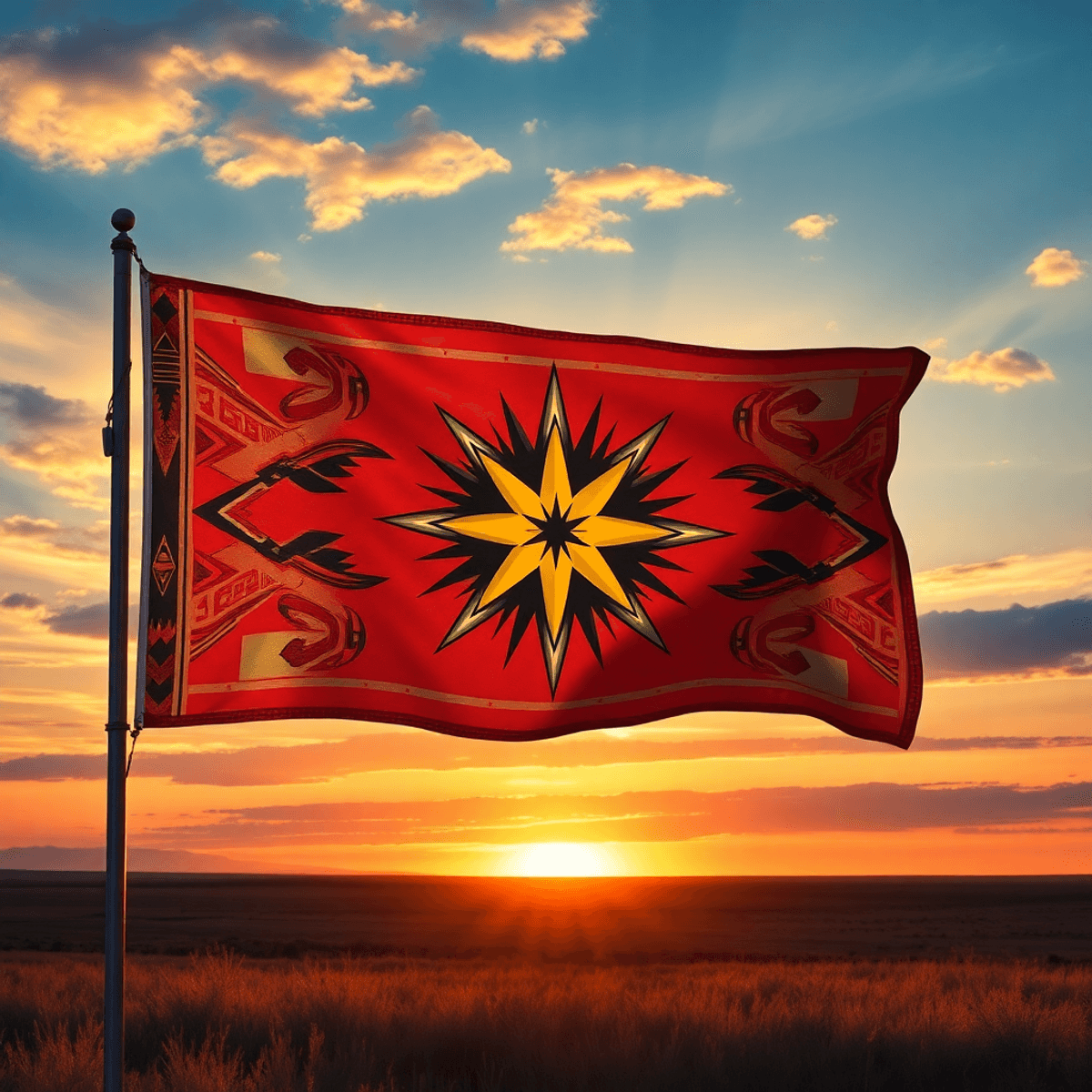
The New Mexico state flag is one of the most recognizable symbols in America. It features the ancient Zia sun symbol, which is a bold red emblem on a golden background. This design holds great significance for the Zia Pueblo people, who have a rich cultural heritage in the American Southwest that dates back centuries.
The Zia sun symbol represents the deep connection between all things, including the four cardinal directions and the cycles of human life. Its precise geometric design and profound meaning have fascinated both locals and tourists, making it an important representation of New Mexican identity.
However, behind this widespread acceptance lies a complex story. While many New Mexicans proudly display the symbol as a way to honor their state’s diverse heritage, there are others who raise valid concerns about cultural appropriation and the respectful use of sacred indigenous imagery.
This article explores the intriguing history of the Zia sun symbol, including:
- Its origins and sacred meaning within Zia Pueblo culture
- The historical journey that led to it becoming New Mexico’s state flag
- Its influence on contemporary artistic expression
- Ongoing discussions about its usage
- Its changing role in shaping New Mexican identity
Understanding the Zia Sun Symbol: Origins and Meaning
The Zia sun symbol carries profound spiritual significance within Native American culture, representing a complex understanding of life’s interconnected nature. At its core, this sacred emblem embodies the Zia Pueblo people’s deep connection to the natural world and their sophisticated cosmological beliefs.

The Design of the Zia Sun Symbol
The symbol’s design follows precise sacred geometric principles. This mathematical precision serves as a visual representation of life’s fundamental patterns.
The Meaning Behind the Symbol
The Four Cardinal Directions
- North: Direction of winter and wisdom
- South: Summer’s warmth and growth
- East: Spring and new beginnings
- West: Autumn and life’s completion
Sacred Numbers in Daily Life
- Four seasons guiding agricultural cycles
- Four daily periods marking time’s passage
- Four life stages from birth to death
- Four sacred obligations to community
The Cultural Significance of the Zia Sun Symbol
The Zia people traditionally used this symbol in ceremonies and sacred art, incorporating it into pottery, textiles, and ceremonial objects. Its circular form represents the eternal cycle of life, while the radiating lines illustrate how all aspects of existence emanate from a single, sacred source.
The Mathematical Precision Behind the Symbol
The symbol’s sacred geometry reflects sophisticated mathematical understanding, with each element carefully positioned to create perfect symmetry. This precision mirrors the Zia belief in universal order and balance, where every component plays a vital role in maintaining cosmic harmony.
The Spiritual Guidance Offered by the Symbol
Traditional Zia teachings emphasize the symbol’s role as a spiritual compass, guiding individuals through life’s journey while reinforcing their connection to community and nature. Each ray serves as a reminder of sacred responsibilities and the interconnected nature of all living beings.
This spiritual guidance is not limited to ceremonial practices but can also be incorporated into daily life, providing individuals with a deeper understanding of their place in the universe.
The Creation of the New Mexico State Flag: A Blend of Cultures
The journey of New Mexico’s state flag began in 1925 when the Daughters of the American Revolution recognized the need for a distinctive state symbol. Before this time, New Mexico had no official flag to represent its unique cultural identity and rich heritage.
A Design Competition
The DAR launched a design competition that would forever change the state’s visual identity. Dr. Harry Mera, a Santa Fe physician and amateur archaeologist, emerged as the competition’s winner. His winning design drew inspiration from a clay pot he discovered at the Zia Pueblo, featuring the sacred sun symbol that would become the flag’s centerpiece.
Cultural Understanding in Design Choices
Dr. Mera’s design choices reflected deep cultural understanding:
- A bold red Zia symbol against a vibrant yellow background
- Colors paying homage to both Native American artistry and Spanish colonial influences
- Simple yet powerful geometric composition that captured the essence of Southwestern aesthetics
To fully appreciate these design choices, one can refer to resources on [how to read a flag](https://lostflags.com/how-to-read-a-flag-colors-shapes-and-hidden-meanings), which provide insights into decoding colors, shapes, and symbols to reveal rich cultural and historical stories.
Significance of the Flag’s Adoption
The flag’s adoption marked a significant moment in New Mexico’s history. It represented one of the first instances where Native American symbolism was prominently featured on official state regalia. The design received widespread acclaim for its artistic merit and cultural significance.
Dr. Mera’s work at the Museum of New Mexico and his interactions with indigenous communities influenced his approach to the flag design. His respect for Zia Pueblo traditions shaped his interpretation of the sacred symbol, though questions about cultural consultation would arise decades later.
Reflecting New Mexico’s Complex Cultural Landscape
The flag’s creation process reflected New Mexico’s complex cultural landscape:
- Native American spiritual elements
- Spanish colonial color influences
- American statehood aspirations
- Modern design principles
This process aligns with broader trends in [the evolution of flag design](https://lostflags.com/the-evolution-of-flag-design-a-vexillologists-guide-to-lost-banners), which offer insights into symbolism, history, and vexillology principles.
Transcending Political Symbolism
The resulting design transcended mere political symbolism, becoming a powerful representation of New Mexico’s multicultural identity. The flag stands as a testament to the state’s unique position as a crossroads of indigenous, Hispanic, and Anglo-American cultures.

Sacred Geometry in Practice: The Zia Sun Symbol on Everyday Objects
The sacred geometry of the Zia sun symbol has gone beyond its original spiritual meaning and has become a powerful artistic motif in modern New Mexican craftsmanship. Artisans all over the state incorporate this ancient design into their work using various mediums and interpretations.
Zia Sun Symbol in Traditional Pottery
Traditional pottery artists include the symbol in their hand-painted designs, often using natural pigments to create intricate patterns that pay tribute to the original sacred significance. The circular shape of pottery vessels provides an ideal surface for the Zia’s radial design, allowing the symbol to wrap seamlessly around the curved surface.
Zia Sun Symbol in Modern Jewelry
Modern jewelry makers create the symbol using various techniques such as:
- Sterling silver pendants with turquoise inlay
- Hand-stamped copper bracelets
- Beaded earrings following the four-directional pattern
- Gold-plated pins featuring minimalist interpretations
Zia Sun Symbol in Daily Life
The symbol can be found in unexpected places throughout New Mexico, including:
- Hand-woven textiles and blankets
- Decorative tile work in homes and public spaces
- Custom furniture with carved or painted designs
- Tattoo art incorporating personal elements with the traditional pattern
Collaboration with Zia Pueblo Artisans
Local artists have come up with innovative ways to maintain the symbol’s geometric accuracy while adapting it to different sizes and materials. Some craftspeople collaborate directly with Zia Pueblo artisans to ensure their interpretations honor the original sacred principles of the design.
Controversies Surrounding Cultural Appropriation: The Case Study of the Zia Sun Symbol
The Zia Pueblo’s sacred sun symbol has become a central point in discussions about cultural appropriation. In recent years, there have been many cases of businesses and individuals using the symbol for commercial purposes without asking for permission or recognizing its spiritual importance.
Legal Challenges by the Zia Pueblo Tribe
The Zia Pueblo tribe has actively fought against these unauthorized uses through legal means. In 1994, they filed a significant lawsuit seeking compensation from New Mexico state for the symbol’s use on the state flag. Although the case didn’t result in financial compensation, it sparked important conversations about indigenous intellectual property rights.
Notable Commercial Misuse Cases
Here are some notable examples of commercial misuse of the Zia sun symbol:
- Brewing companies incorporating the symbol on beer labels
- Sports teams adopting the design for merchandise
- Tattoo artists offering the symbol without cultural context
- Corporate logos appropriating the sacred geometry
Ongoing Challenges and Unauthorized Uses
Despite establishing a formal process for requesting permission to use the symbol, many entities continue to ignore this protocol. A survey conducted in 2016 revealed over 3,000 unauthorized uses of the Zia sun symbol in commercial products and marketing materials.
Questions About Cultural Ownership
The widespread adoption of the symbol raises complex questions about cultural ownership in today’s society. While some argue that sharing cultures enriches society, the Zia Pueblo believes that sacred symbols deserve special protection and respect.
Efforts to Educate Businesses
To address these issues, the New Mexico Department of Cultural Affairs is now collaborating with tribal representatives to educate businesses about proper usage protocols. These initiatives aim to strike a delicate balance between celebrating shared heritage and safeguarding indigenous cultural rights.
Trademark Applications and Indigenous Rights
Recent trademark applications featuring the Zia sun symbol are facing closer examination, with the U.S. Patent and Trademark Office considering tribal interests in their review process. This shift signifies a growing recognition of indigenous communities’ rights to maintain control over their sacred symbols.
Embracing Complexity: The Modern Significance of the Zia Sun Symbol for New Mexicans Today
The Zia sun symbol resonates deeply with New Mexicans across diverse backgrounds, creating a unique cultural bridge between past and present. Local artist Maria Sanchez describes her connection to the symbol:
“Growing up in New Mexico, the Zia became part of my identity. It represents our shared heritage while reminding us to honor its sacred origins.”
This sentiment echoes throughout the state, where residents have developed a nuanced understanding of the symbol’s dual nature. Many New Mexicans incorporate the Zia thoughtfully into their lives through:
- Community art projects that celebrate indigenous history
- Educational programs in schools teaching proper cultural context
- Collaborative events between Native and non-Native communities
The New Mexico Department of Cultural Affairs has launched initiatives to deepen public understanding of the Zia symbol’s significance. These programs include:
- Museum exhibitions showcasing authentic Zia Pueblo artifacts
- Cultural workshops led by Zia Pueblo members
- Educational materials distributed to schools and businesses
- Public forums discussing respectful symbol usage
Local organizations have partnered with Zia Pueblo representatives to develop guidelines for appropriate symbol use. The “Respect the Zia” campaign teaches businesses and individuals about obtaining proper permissions while encouraging meaningful cultural exchange.
Young New Mexicans particularly embrace this educational approach. High school student James Martinez notes:
“Learning about the Zia’s meaning has made me proud of our state’s commitment to preserving indigenous wisdom while building bridges between communities.”
These efforts reflect a growing awareness that meaningful appreciation requires both understanding and respect, transforming how New Mexicans relate to this powerful symbol of their shared heritage.
However, it’s essential to remember that symbols like the Zia carry profound spiritual meanings and historical significance, much like other sacred symbols from indigenous cultures that have been lost over time. Such symbols often encapsulate deep cultural and spiritual meanings which should be respected and preserved.
Furthermore, just as some flags represent a blend of spiritual power and national identity, the Zia symbol also embodies a similar duality, serving as both a cultural emblem for New Mexicans and a significant spiritual symbol for the Zia Pueblo people.
Conclusion
The Zia sun symbol is a powerful example of how sacred geometry continues to influence modern symbols. This ancient design, with its carefully arranged rays and significant numbers, represents the cultural evolution of New Mexico over the centuries.
The journey of the symbol—from being an important part of Zia Pueblo art to becoming a state emblem—reveals its complex meanings that still resonate with various communities today. It sparks important conversations about preserving culture, representing it respectfully, and embracing shared heritage.
By exploring the rich history and sacred geometry behind the Zia sun symbol, we can deepen our appreciation for the stories embedded in everyday symbols. Flags are more than just colors and shapes; they embody living histories, sacred traditions, and ongoing dialogues between the past and present.
The legacy of this symbol encourages us to go beyond surface-level understanding and strive for deeper cultural comprehension. It calls upon New Mexicans—and everyone who encounters it—to honor its ancient wisdom while also recognizing its evolving role in shaping contemporary identity.