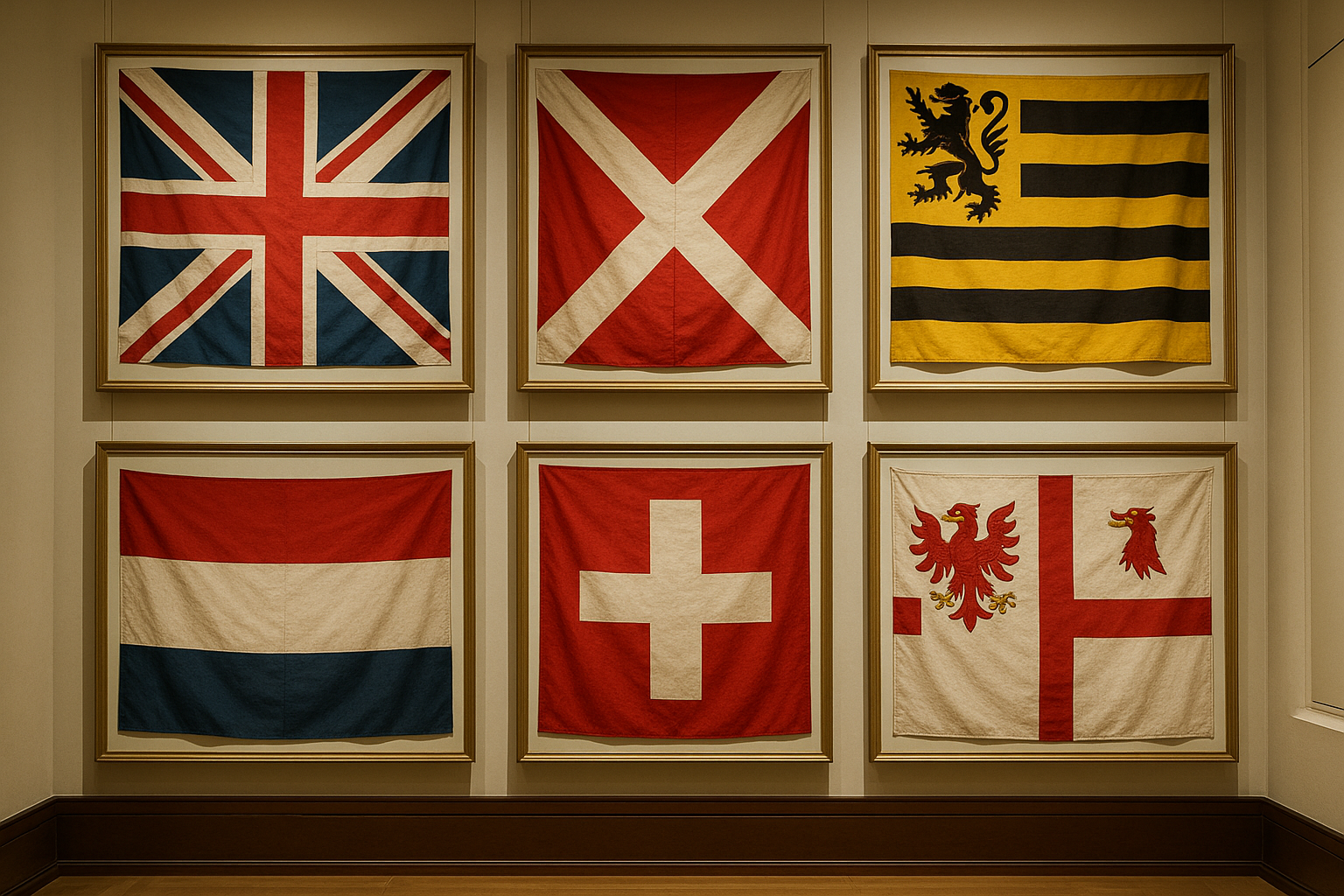
In the past, during battles, how did knights know who their allies were and who their enemies were? The answer lies in heraldry – a complex system of visual symbols that influenced the development of flags as we know them today.
Heraldry became an important way for people in medieval Europe to identify each other. It used unique combinations of colors, animals, and shapes to create distinct visual symbols. These designs were displayed on shields, banners, and armor, representing the identity and power of noble families and knights.
The impact of medieval heraldry on early flag design is significant. Many modern national flags still bear the influence of this tradition. For example, England’s flag features a proud lion, while Russia’s flag displays a double-headed eagle. These ancient symbols continue to represent countries around the world.
This exploration will show how heraldic elements such as majestic creatures, bold shields, and distinctive crests evolved from personal identifiers into lasting symbols of national pride and identity that still captivate us today.
The Origins of Medieval Heraldry
Medieval heraldry began in 12th century Europe during a time of significant military and social change. The widespread use of full-face helmets in battle created an urgent need for visual identification systems among armored knights.
The Early Days: Shields and Banners
The earliest recorded instances of heraldic designs appeared on shields and banners during the First Crusade (1096-1099). Knights painted distinctive patterns on their shields to identify themselves to allies amid the chaos of battle. These initial designs were simple – geometric shapes and bold colors that could be recognized from a distance.

Evolution of Heraldry: By 1150
By 1150, heraldic symbols had evolved into a sophisticated system of identification:
- Personal Marks: Knights adopted unique combinations of colors and symbols
- Family Legacy: Designs passed down through generations
- Social Status: Specific symbols indicated noble rank and lineage
Tournaments: The Rise of Formal Heraldry
The development of formal heraldry coincided with the rise of tournaments – mock battles where knights displayed their prowess. These events popularized heraldic displays beyond the battlefield, transforming them into symbols of family pride and social standing.
Influences on Early Heraldic Designs
Early heraldic designs drew inspiration from multiple sources:
- Ancient tribal symbols
- Religious imagery
- Local flora and fauna
- Geometric patterns
Regulation and Recording: The 13th Century
The practice of recording and regulating heraldic designs began in the 13th century. Professional heralds maintained detailed registers of coats of arms, ensuring each design remained unique. These records, known as rolls of arms, documented the evolution from simple battlefield identifiers to complex family emblems.
Growth in Sophistication: Seals and Coats of Arms
The sophistication of heraldic art grew as medieval society became more structured. Seals used on official documents incorporated heraldic elements, while noble houses commissioned elaborate coats of arms for display in their castles and churches. This period also saw a rise in the use of heraldry in wine labels, reflecting the growing importance of this beverage in French culture and its association with nobility.
Heraldic Symbols in Flags: A Closer Look
The Significance of Animals in Flag Designs
Animals dominated medieval heraldic symbolism, carrying deep cultural significance in flag designs. The lion emerged as the most prevalent creature, symbolizing strength and nobility across European flags. Notable examples include:
- The rampant lion of Scotland’s royal banner
- The three lions of England’s royal standard
- The crowned lion of Bohemia’s historical flag
Beyond lions, other heraldic animals shaped flag identities:
- Eagles – symbolizing imperial power
- Dragons – representing fierce protection
- Griffins – depicting noble vigilance
- Panthers – showing fierce protection
Geometric Patterns and Their Meanings
Geometric patterns played an equally vital role in heraldic flag design. Shield shapes created distinctive visual frameworks, while specific patterns carried coded meanings:
- Bend – diagonal stripe representing a knight’s belt
- Chevron – inverted V-shape showing protection
- Fess – horizontal band symbolizing military belt
- Cross – religious devotion and crusader heritage
These distinctive designs served practical battlefield purposes. Knights needed instant recognition at great distances, leading to bold color combinations and striking patterns. The practice of counterchanging – contrasting colors divided by a line – enhanced visibility and memorability.
The Role of Crests in Identification
Crests added another layer of identification, typically appearing at the top of flags. These three-dimensional elements ranged from elaborate animal heads to architectural features, creating unique silhouettes that distinguished noble houses even from afar.
The combination of these elements – animals, geometric patterns, and crests – created a sophisticated visual language that transformed medieval flags into powerful symbols of identity and authority.
Beyond Heraldry: Other Symbolic Dimensions of Flags
However, the story of flags is not limited to heraldic symbols. Many flags have served as vessels for sacred symbols with deep cultural and spiritual meanings, particularly in indigenous contexts. On the other hand, some flags have represented theocratic values, where spiritual power and national identity unite, reflecting divine authority and political rule.
Moreover, the history of flags is often marked by change and transformation. Understanding why countries change flags can provide insight into the socio-political dynamics at play.
Interestingly, the concept of flags extends beyond our reality into the realm of mythology. The imagined flags from mythical realms like Atlantis or Hyperborea, symbolize lost civilizations and ancient myths, showcasing the profound impact of flag symbolism throughout history and culture.
From Personal Coats of Arms to National Symbols: The Transition in Flag Development
The transformation from personal heraldic designs to national symbols marked a pivotal shift in flag development during the medieval period. Noble families’ coats of arms became deeply intertwined with the territories they governed, creating lasting visual legacies that shaped national identities.
The Influence of Noble Heraldry on Flag Design
A prime example lies in the Austrian flag’s origin, derived from the Babenberg dynasty’s coat of arms. The distinctive red-white-red pattern, according to legend, emerged from Duke Leopold V’s blood-stained white tunic after battle – a personal heraldic story that evolved into a powerful national symbol.
Similar patterns emerged across Europe:
- The Scottish royal banner incorporated the lion rampant from the personal arms of William I
- Luxembourg’s red-white-blue tricolor stems from the House of Luxembourg’s coat of arms
- The Danish Dannebrog adapted the crusader’s cross from noble heraldic designs
Municipal Flags and Their Connection to Ruling Nobles
Towns under noble protection often adopted modified versions of their ruling families’ arms. These municipal flags created a visual hierarchy that connected local communities to their governing nobles:
- Direct Adoption: Towns using the complete family coat of arms
- Partial Integration: Incorporating select elements from noble heraldry
- Color Preservation: Maintaining the noble family’s heraldic colors while creating unique designs
The House of Habsburg exemplifies this transition – their personal lion symbol spread across their vast territories, appearing in modified forms on numerous regional flags and coats of arms. This practice established a visual network of power and influence that transcended individual family representation, laying groundwork for modern national flag designs.
Global Expansion of Flag Design through Colonialism
However, it’s important to note that this evolution wasn’t limited to Europe alone. The influence of colonialism led to a significant expansion in flag design and usage around the world. As empires expanded their reach, they brought their heraldic traditions with them, resulting in a fascinating blend of styles and symbols. This colonial and maritime flag history is a testament to how flags have served as powerful symbols of identity and authority throughout history.

The Lasting Influence of Heraldry on Flag Design Across Europe and Beyond
Heraldry, the study of coats of arms and emblems, has significantly influenced the design of flags in Europe and beyond. Many national flags today still bear the colors and symbols used in heraldry.
The Role of Colors in Flags
The traditional heraldic colors, known as tinctures, continue to play a vital role in European flag designs:
- Metals: Gold (yellow) and Silver (white)
- Colors: Red, Blue, Black, Green, Purple
- Furs: Patterns representing ermine and vair
These classic combinations can be seen in flags such as Belgium’s black, yellow, and red tricolor or Poland’s white and red bicolor—both derived from ancient heraldic arms.
Animal Symbols as National Identifiers
Animal symbols from medieval heraldry remain powerful national identifiers across Europe. For example:
- The double-headed eagle appears on flags and emblems of Albania, Montenegro, Serbia, and historically Russia.
- The lion, another prominent heraldic beast, features in Norway’s coat of arms, Finland’s national emblem, Bulgarian state symbols, and Czech Republic’s heraldic designs.
Global Spread of Heraldic Influences
Heraldic influences have extended beyond Europe through colonization and cultural exchange. The American Great Seal incorporates the heraldic eagle, while many Commonwealth nations retain British heraldic elements in their flags and emblems.
Practical Applications of Heraldic Principles
Modern flag designers still draw inspiration from heraldic principles when creating new flags. One such principle is the rule of tincture, which advises against placing colors on top of each other or metals on top of each other in order to maintain visibility and recognition from a distance.
This practical application of medieval heraldic wisdom demonstrates its ongoing relevance in contemporary vexillology—the study of flags.
Exploring Flag Designs Further
To gain a deeper understanding of these flag designs and their meanings, one can explore various resources that delve into different aspects related to flags:
- How to read a flag by decoding its colors, shapes, and symbols
- Flags of fictional nations that represent creativity and imagined identities
- Rebel flags throughout history that symbolize defiance during uprisings
- Forgotten country flags with compelling stories about lost nations
- Pirate flags with unique symbols that instilled fear in maritime history
These explorations offer insights into rich cultural narratives associated with both real-world and fictional flags while also shedding light on significant historical events shaped by various movements or groups. For instance, the symbolism behind various rebel flags throughout history provides a fascinating glimpse into the defiance embodied by these banners during uprisings.
The Regulation and Global Spread of Heraldic Traditions in Flag Design
The growing complexity of heraldic designs in flags necessitated formal regulation. The College of Arms, established in 1484 by Richard III of England, became a pioneering institution for standardizing heraldic practices. This royal organization maintained strict control over the creation and use of coats of arms, ensuring authenticity and preventing unauthorized appropriation of noble symbols.
Similar regulatory bodies emerged across Europe:
- The Court of the Lord Lyon (Scotland)
- The Office of the Chief Herald (Ireland)
- The Cronista Rey de Armas (Spain)
These institutions created detailed documentation systems and enforced specific rules for incorporating heraldic elements into flags. Their influence extended beyond nobility to civic institutions, military units, and educational establishments.
Heraldic traditions spread globally through colonization, trade, and cultural exchange. Nations across different continents adopted European heraldic principles while infusing local symbolism. A significant aspect of this global spread was the role played by colonial trading companies, whose flags often reflected a blend of heraldic traditions and local elements. For a deeper understanding of how these trading company flags shaped global history, you can explore some notable examples.
In Latin America, countries like Mexico and Peru incorporated Spanish heraldic traditions while adding indigenous symbols. In Commonwealth Nations such as Australia, New Zealand, and Canada, British heraldic influences are evident in their flag designs. Meanwhile, Japan developed mon (family crests) systems that run parallel to European heraldry.
The global adaptation of heraldic principles has resulted in unique hybrid designs. The South African flag combines Dutch heraldic influences with African symbolism. The Brazilian flag features a celestial globe within a traditional heraldic roundel, demonstrating how nations reimagined European heraldic conventions through local cultural lenses.
Modern heraldic authorities continue to guide flag design by maintaining databases of registered symbols and providing expertise for new flag proposals. Their work ensures historical accuracy while allowing contemporary interpretations of ancient heraldic traditions. As we delve into the evolution of flag design further, it’s important to understand how these changes reflect broader trends in vexillology, offering insights into the symbolism and history behind lost banners.
Conclusion
Medieval heraldry’s influence on flag design shows the lasting power of visual symbolism. The journey from knights’ personal emblems to national flags demonstrates how these ancient design principles continue to shape modern vexillology.
The rich variety of heraldic elements—majestic lions, soaring eagles, bold geometric patterns, and vibrant color combinations—lives on in flags worldwide. These symbols bridge centuries of human history, connecting us to the medieval knights who first displayed their distinctive coats of arms on European battlefields.
The study of heraldry and flag development offers endless opportunities for exploration. Here are some ways you can delve deeper into this fascinating field:
- Research your local region’s heraldic heritage
- Examine the hidden meanings behind familiar flag designs
- Visit heraldic museums and collections
- Join vexillological societies
Each flag tells a unique story, woven from threads of heraldic tradition. Understanding these connections enriches our appreciation of the symbols that unite communities and nations across the globe.